Failover Architecture Patterns for MSP-Managed Workloads
Match each workload's recovery needs to the MSP's infrastructure layers.
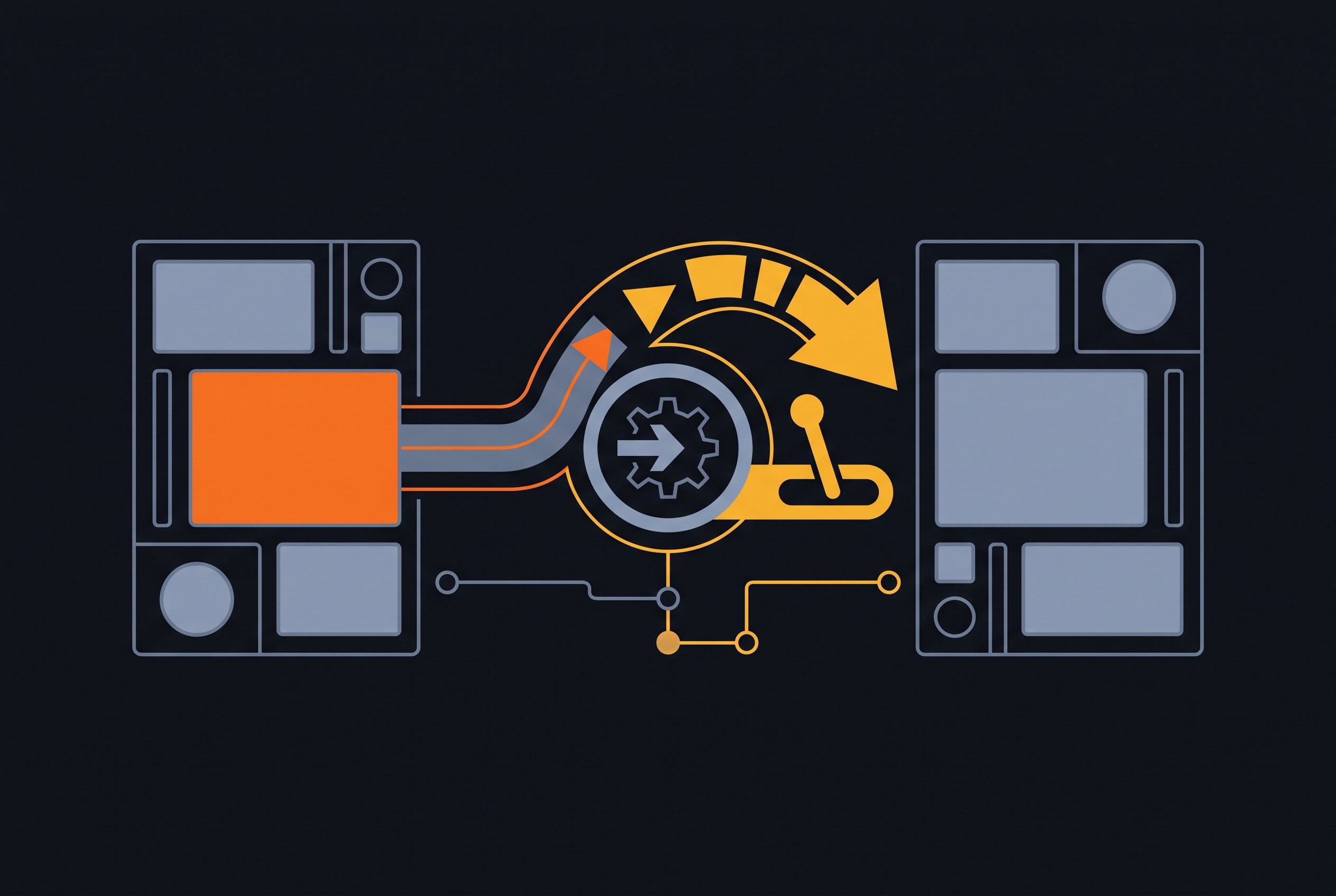
Failover architecture for MSP-managed workloads is a matching problem. The right design joins each workload’s recovery objectives to the layers the MSP owns, then selects, automates, and tests the least complex pattern that satisfies both.
Why failover design for MSP workloads is harder than it looks
MSPs operate across clients with different workloads, criticality tiers, and contractual obligations, often on shared infrastructure. Generic disaster recovery advice assumes a clearer boundary around the system and the team responsible for recovering it. In a managed environment, one recovery procedure cannot stand in for all those obligations. The same infrastructure may support workloads whose tolerance for interruption differs sharply.
Shared responsibility makes this harder. Cloud providers secure the platform, MSPs operate detection and response above it, and clients retain decisions and records. Yet service contracts often describe the client-to-provider relationship without saying where the MSP-to-platform boundary lies. A technically sound recovery sequence can therefore stall over who owns a layer or authorizes a transition. Pattern selection and responsibility mapping must happen together.
How RTO and RPO actually constrain which patterns are available
Recovery Time Objective, or RTO, defines the maximum acceptable downtime. Recovery Point Objective, or RPO, sets how much data loss is acceptable. These targets eliminate unsuitable patterns before cost becomes the deciding factor. A workload cannot meet its downtime limit through a restore process that takes longer than that limit, nor meet its data-loss limit through replication that leaves a larger gap.
Confluent Cloud DR documentation states the architectural constraints directly. Zero RPO requires synchronous replication, while zero RTO requires an active-active setup. The objectives constrain architecture independently, so a running standby does not by itself establish an acceptable recovery point. Likewise, a current data copy does not establish that the application can resume quickly enough.
The business impact analysis provides the starting point for assigning both targets. It ranks assets by criticality, links each tier to a backup method and schedule, and puts the objectives in writing for client sign-off. Compliance requirements must be checked before those targets are finalized, since client preferences may not satisfy the applicable obligations. A payment-processing service and a monthly reporting job thus each need a place in a per-workload tier map, which guides the choice of pattern.
The four canonical failover patterns and what each one actually trades
Backup and Restore occupies the lowest-cost end of the spectrum, with an RTO measured in hours to days. The MSP maintains backups and the procedures needed to reconstruct the service. This suits non-critical workloads where the interruption is contractually and operationally acceptable. Its central weakness is an unproven restore procedure, particularly when testing does not keep pace with change.
Pilot Light keeps replicating core data while leaving a minimal amount of infrastructure idle. Its tens-of-minutes RTO reflects the work still needed to bring the recovery environment into service. The MSP must keep that environment aligned with production despite its limited activity. Configuration drift is the primary failure mode because an available data copy cannot compensate for an outdated recovery configuration.
Warm Standby keeps a scaled-down production replica running all the time. Recovery becomes a scale-up and traffic-switch operation rather than a build-from-scratch exercise, supporting an RTO measured in minutes. The MSP trades that recovery headroom for medium-to-high cost, materially below full active-active operation. The remaining operational exposure lies in completing the scale-up and traffic switch within the target.
Active-Active Multi-Region runs full workloads in multiple regions at the same time and costs the most and is the most complex. Near-zero recovery objectives are achievable, but zero data loss still requires synchronous replication. Distance increases replication latency and complicates the write path, while traffic redirection remains an implementation responsibility. Confluent Cloud DR documentation illustrates that limit by requiring manual or application-level redirection rather than supported automatic failover in active-active deployments.
An MSP-managed environment may use active-active for tier-one services, warm standby for tier-two services, and backup-and-restore for archival workloads.
How failover behaves differently across compute, database, networking, and DNS layers
Compute recovery is relatively straightforward when application servers are stateless. A correctly configured load balancer can redistribute traffic across availability zones without checking data integrity. However, sticky sessions or stateful data cached in one zone break that assumption.
Database recovery requires a separate decision because the service holds state. Replication lag must remain within the workload’s RPO tolerance before a replica is promoted. The MSP must monitor that lag continuously. A healthy compute tier cannot make an out-of-tolerance database replica safe to promote.
Networking recovery should use data-plane actions so it can work without control-plane configuration changes during an outage. Route 53 routing controls and health checks illustrate this approach without defining the only implementation. The switching mechanism must be prepared before the event. A regional failure may degrade the control plane that an improvised network change would need.
DNS adds its own recovery delay through propagation. Preconfigured routing policies with health-check-based failover remove the manual editing step, while low TTLs must be set in advance. These four layers then need a dependency map that defines their recovery order. An application in one cloud and its database in another require a plan spanning both, or individually restored components can still leave the service unavailable.
Why automated runbooks and Infrastructure as Code are now prerequisites, not enhancements
Once the plan sets out how each layer recovers, the steps must stay in that order even under the pressure of an incident. Automated runbooks keep steps that depend on each other in order, including database promotion before traffic switching. A static document cannot keep pace with a managed environment that changes continuously. Automation makes the recovery sequence executable rather than leaving operators to interpret it during an outage.
Infrastructure as Code helps tackle configuration drift, which is a particular threat to pilot light environments. A declarative recovery environment makes differences between primary and standby detectable and correctable before failover. The runbook can then be exercised repeatedly in non-production against a defined configuration. This connects the intended architecture to the environment that must actually recover.
Technical automation does not resolve missing authority. Tabletop exercises must still establish who can approve failover and whether escalation contacts are current. Failover and failback also need testing as a pair, since successful departure from the primary environment does not prove a safe return. Tenant-deletion flows require attention as part of that operational coverage.
Cloud providers secure the platform, MSPs operate detection and response above it, and clients retain decisions and records.
The ransomware constraint that changes the backup tier of every failover design
Infrastructure failover assumes that a recovery point is still usable after the incident. Ransomware challenges that assumption by targeting backup repositories, where encryption or deletion can remove the copies needed for recovery. A replicated or running standby does not remove the need to protect the backup tier. Immutability is therefore a design constraint across patterns.
The 3-2-1-1 rule expresses that requirement as three copies of data on two different media types, with one copy off-site and one copy immutable. The immutable copy is the addition that distinguishes it from the traditional 3-2-1 rule. Because that copy cannot be altered or deleted, its requirements affect eligible backup destinations and retention policies. Pilot light and warm standby designs remain structurally exposed if their backup recovery points lack that protection.
Cyber insurers increasingly require tested, verified backups, documented recovery targets, and immutable or isolated copies before issuing or renewing coverage.
How sovereign and regulated workloads constrain multi-region failover choices
Sovereignty adds a third constraint to recovery time and data loss. If data and control must remain within a jurisdiction, unrestricted multi-region active-active is not an available answer. The workload classification must establish those limits before the MSP chooses a region or replication mode. Otherwise, a design that satisfies its recovery targets may still be ineligible.
The available approaches carry distinct compromises. Sovereign-active with global-passive standby trades recovery time and data currency for sovereignty, where the permitted standby arrangement allows it. Active-active within a sovereign cluster with a global read-only edge supports low local latency but complicates cross-sovereign replication. A split-plane model places the control plane in a standard region and the data plane in a sovereign region, improving operational ergonomics but requiring strong identity and encryption boundaries. Each approach remains conditional on what the workload’s jurisdictional rules permit.
Replication distance further narrows the choice. Synchronous replication needs low-latency links, while asynchronous replication can span greater distances at the cost of a data-loss window. Routing must also avoid prohibited geographies during both normal operation and recovery.
Why Kafka and event-streaming workloads require DR treatment as first-class infrastructure
A regional cluster outage in mission-critical Kafka workloads interrupts the producers and consumers that rely on it. Confluent Cloud DR documentation defines the recovery goal as an up-to-date replica of primary-cluster data and metadata on a separate DR cluster. The MSP must also make client reconnection, consumer group offsets, access permissions, and bootstrap endpoint routing part of the recovery design.
Active-passive recovery with manual switchover may need application restarts, changes to the configuration, or custom discovery logic. Its achieved RTO depends on the MSP’s tooling and procedures. Active-active needs bidirectional topic replication and multi-cluster connection handling, along with application-level traffic redirection and offset management that is more complex.
Mirroring lag determines the recovery point available to the streaming workload. Confluent Cloud DR documentation exposes that lag through its Metrics API, CLI, REST API, and console. Continuous visibility lets the MSP assess the RPO the environment can actually deliver. Together, client reconnection, replicated state, and endpoint routing make Kafka recovery a coordinated workload operation.
How chaos engineering and continuous DR testing replace periodic drills
A designed and automated pattern is only as credible as its most recent verified test. Services, configurations, and third-party API dependencies change, widening the gap between the documented recovery plan and the live environment. Testing frequency must therefore match change frequency.
Chaos engineering makes that discipline concrete through deliberate failure injection. Tests establish whether load balancers redirect traffic, databases fail over, and the service remains within its SLO. They also expose hidden single points of failure, including zone-local state in services presented as multi-AZ. Tests must cover the return path and tenant-deletion flows as well as the point when traffic first reaches the recovery environment.
Tabletop exercises complement those technical tests by exercising approval, escalation, and communication. Their findings turn governance assumptions into documented responsibilities. Together, the tests and exercises produce restore-test records, recovery targets, and immutable-copy verification. That evidence makes the testing program a client deliverable that also supports regulatory audits and cyber insurance applications.
A repeatable MSP framework for matching patterns to workloads across every engagement
The framework starts with business impact and jurisdiction to give each workload a criticality tier, sovereignty classification, and signed-off recovery targets. Those inputs rule out choices in the four-pattern spectrum that the workload cannot use. Cost then distinguishes among designs that can satisfy the targets. If sovereignty removes the required pattern, that conflict becomes an explicit decision for the engagement.
The chosen pattern becomes a recovery design for each layer, with a map of the cross-cloud and cross-platform dependencies. Each layer needs a defined mechanism that can work even if the control plane is unavailable during recovery. Automated runbooks encode the sequence, while Infrastructure as Code defines the standby environment. Non-production execution then produces evidence that the sequence works against that configuration.
Backup hardening adds the independent requirement for 3-2-1-1 protection. It also requires checking that repositories are isolated from the primary environment and inaccessible through the same credential paths an attacker would traverse. Continuous validation tests the full recovery cycle at the environment’s rate of change and adds tabletop evidence for governance. The final output must document which steps the MSP owns, which the client approves, and which the cloud provider handles. That boundary completes the architecture by assigning responsibility for the recovery it promises.
Sources
- Disaster Recovery and Failover on Confluent Cloud
Provided the architectural constraints linking RPO/RTO to replication modes, the active-active manual redirection limitation, and the Kafka DR recovery goals including mirroring lag visibility.