Communication Protocols During Active IT Outages
Structured communication roles and protocols reduce outage damage more than technical fixes alone.
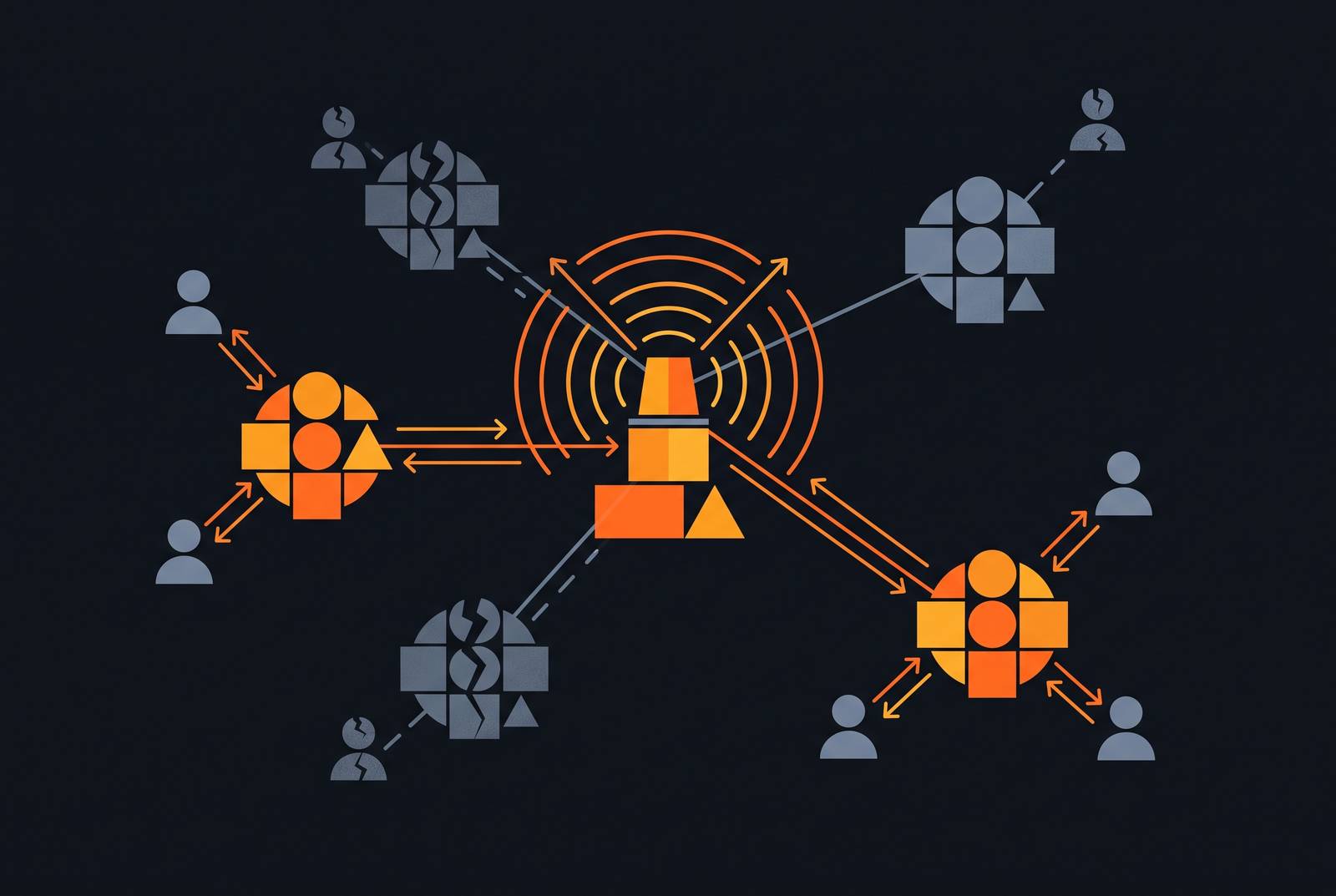
Outage communication is a structured discipline bolted onto incident response, with its own roles, timing, and failure modes, and organizations that treat it that way suffer less financial and reputational damage than those who wing it. The money involved is not small. Splunk and Cisco's "Hidden Costs of Downtime 2026" report puts average downtime cost at $15,000 a minute, with unplanned outages costing the Global 2000 $600 billion a year. The ITIC 2024 Hourly Cost of Downtime Survey found 93% of organizations say an hour of downtime costs over $300,000, and 41% put it between $1 million and $5 million or more.
Scaled up to a real event, the numbers stop looking abstract. The CrowdStrike outage in July 2024 cost the Fortune 500 a combined $5.4 billion in days, a clear picture of cascading failure once one technical fault touches systems it was never supposed to BigPanda War Room Definition SupportBench Incident Management Playbook. Duration matters too.
None of this is really about the technical fault itself. Atlassian's incident management guidance shows customers kept in the loop react less harshly and are less likely to leave afterward: silence during downtime costs more trust than the downtime itself. What follows is a protocol built around defined roles, sequenced stages, and audience-matched messaging, detailed enough to be usable under pressure rather than just plausible in a slide deck. Uptime Institute's Global Data Center Survey found a median outage of 53 minutes, yet 18% last over 4 hours and 6% exceed 24 hours, with communication gaps compounding damage the longer it runs Uptime Institute 2025 Global Data Center Survey BigPanda War Room Definition SupportBench Incident Management Playbook.
The New Government Standard for Outage Communication, September 2026
The document was informed by real events like the Cloudflare outage of November 18, 2025, and by industry partners including Microsoft, Sophos, Cloudflare, and American Water. That mix of government authorship and named private-sector input is itself a signal. This is not theoretical guidance written in a vacuum; it is built from what actually happened when a major provider went down and the world watched how it responded.
The scope is broader than most people would guess from the title. The guidance is aimed at government agencies, critical infrastructure operators, and private-sector service providers alike, and it explicitly flags telecommunications, cloud platforms, managed service providers, industrial control systems, transportation networks, energy operations, and water utilities as domains where an outage can cascade well past the company where it started. The framing is deliberate, and it is stronger than a generic call to "communicate more." CISA asked specifically for clarity, accountability, and transparency, and Dark Reading's September 11, 2026 coverage described the advisory as a reframe making candid disclosure the expected baseline.
That reframe collides with an existing legal reality. All 50 US states already require data breach reporting, and federal agencies including CISA and the SEC require prompt disclosure. Align messaging with legal counsel before anyone makes an attribution statement, because the regulatory clock is already running whether or not a company feels ready to talk. For the argument this piece is making, the significance is straightforward. A federal advisory co-signed by five countries just told the market that pre-planned, structured communication is the expected floor, not optional polish atop good engineering.
The governance structure that makes structured communication possible
Communication cannot be improvised during an outage if nobody was assigned to own it beforehand. That is the whole argument in one sentence, and most of the failures traced back to it. The Incident Commander is the single accountable leader: sets priorities, assigns roles, manages stakeholder communication, and makes calls while the technical picture is still murky. The IC does not diagnose the fault or write the fix. Its value lies in keeping situational awareness intact and ensuring the right people work the right problems instead of duplicating effort or talking past each other.
The Communications Lead is the voice of the incident to everyone outside the war room. CISA's guidance describes this function almost as an orchestrator managing information flow internally and externally, not just relaying updates. The guidance also calls for a separate designated spokesperson, with approval paths for what they can say decided in advance, not negotiated live. The Scribe's job sounds clerical until the review starts: documenting decisions, actions, and timestamps in real time, forming the backbone of the postmortem and, in regulated industries, of later regulatory reports.
CISA's guidance describes a full cross-functional team beyond these core roles—engineering, communications, legal, risk, and customer support—each with a primary and alternate contact named ahead of time. For incidents touching government stakeholders, CISA calls out a government relations lead who keeps messaging to officials consistent with public statements. That consistency detail keeps officials and the public reading the same account of the event. A regulator and a customer reading two different versions of the same event is its own kind of failure.
A lean version works for smaller incidents—incident commander, one technical responder per affected system, a communications lead, and a scribe—expanding only once unexpected dependencies surface. The war room—called a command center, incident bridge, or crisis room—is the single source of truth for status, decisions, and actions, and is associated with a 20 to 40% reduction in resolution time versus async chat coordination. Severity tiers connect this to actual behavior: once a defined threshold like a full-system SEV1 outage is crossed, the major incident protocol kicks in automatically. Wider audience, more frequent updates, executives pulled in. Skipping this governance lets the "communications lead" default to whoever answers the phone first—nearly the opposite of CISA's standard.
What to communicate, to whom, and through which channel
Treating every audience the same wastes time twice: it buries non-technical stakeholders in diagnostic noise or starves responders of needed detail. Internally, audiences split into technical responders, executives, legal, customer support, sales, and PR, each needing something different. The technical channel, the war room bridge or chat, is where jargon belongs and detail should be exhaustive. The executive channel needs business risk, high-level impact, and decision points requiring an executive call. Legal and compliance run as a parallel track, coordinating message approval before anyone makes a statement that touches attribution.
Externally, the split is customers, partners, regulators, and the public, and the status page sits at the center of that whole structure. It should be the single authoritative source for external updates, in plain language focused on what users experience rather than internal infrastructure details. A status page kept current cuts inbound support ticket volume, since customers stop calling and emailing once they can check for themselves. Email works for direct notification once impact is confirmed and significant. Social media needs its own plan, since a badly worded post can become a firestorm if messaging isn't pre-decided, and that channel belongs to the communications lead, not whichever engineer has the password. Regulatory and government channels run as their own stream, coordinated with legal and timed carefully relative to when the public finds out.
Effective outage communication starts with a factual summary built for a specific, predefined audience, not one generic statement copy-pasted across every channel. Nearly every postmortem of a badly handled incident lists the same mistakes: leading with reassurance instead of fact, attributing before root cause is confirmed, or announcing conclusions while the investigation is open. The discipline is simple to state and hard to hold to under pressure. Save the technical detail for internal channels. External messaging describes impact and next steps, and nothing more.
The sequenced communication timeline from first alert to resolution
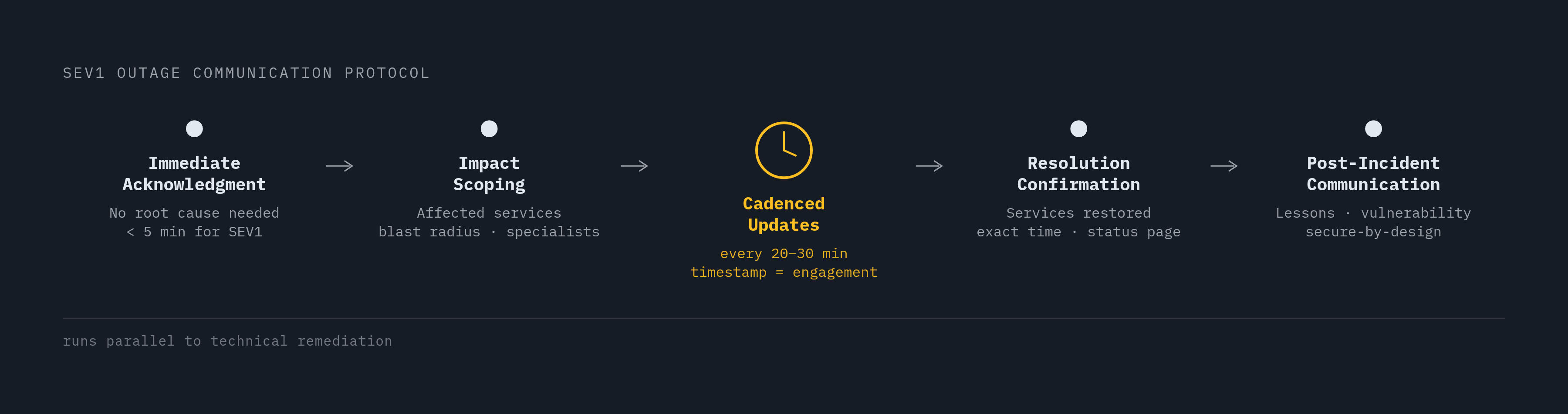
Communication runs parallel to technical remediation. It does not wait for remediation to finish and then get written up afterward. Stage one is immediate acknowledgment, published the moment the issue is confirmed, requiring neither root cause nor ETA. A message as plain as "we know, we're working on it" does real work limiting speculation and panic, per CISA's guidance.
Stage two is the impact scoping update, issued once initial triage wraps up. Here the team shares what's known: affected services, blast radius, and whether the right specialists are engaged. The severity tier gets referenced internally here too, so the tone of what goes out matches how serious the situation actually is. Root cause stays off the table if the investigation is ongoing, since premature conclusions are exactly the risk CISA's guidance names.
From there, cadenced updates follow—every 20 to 30 minutes for a SEV1, even with nothing new to report. That last part is not filler. CISA treats the timestamp itself as a signal: a fresh timestamp, even on "no change," reads as active engagement rather than abandonment. Every update should say when the next one is coming, so nobody is left guessing. Resolution gets confirmed clearly and specifically: which services are back, and when. The status page does not just quietly go dark. The resolution message is part of the protocol, not an afterthought tacked onto the end of it.
None of this is free, but the alternative costs more. Cadenced updates cut inbound support volume since customers aren't left guessing, and IBM's 2024 Cost of a Data Breach Report put the global average breach cost at $4.88 million, a real share being the support and reputational burden clear communication limits. For a SEV1 incident, acknowledgment within 5 minutes is the benchmark.
When transparency and operational security conflict
Not everything can go out in real time, and CISA is direct about that. Publishing certain details mid-incident can show an adversary still active inside what defenses are doing. Sharing configuration details can point other customers with similar setups toward the same vulnerability. Early attribution can wreck a law enforcement investigation before it starts, and public commentary can push a threat actor to change tactics mid-attack. CISA's answer is a risk-informed approach: weigh what a given detail actually does before releasing it externally.
The question worth asking before every release is a narrow one. Does this detail help affected users limit their own impact, or does it just create new risk for nothing? In practice, legal counsel reviews messaging before attribution goes out, and law enforcement coordination happens before confirming malicious activity publicly. The result: acknowledging the incident, describing observable impact, naming what's under investigation, and omitting specifics that could be weaponized elsewhere. That is a disciplined account of what happened. It is disclosure released in the right order rather than all at once.
Those two things sound like they should contradict each other. They don't, once the sequencing is right. Dark Reading's September 11, 2026 coverage states CISA is pressing for "communicating strategically" rather than "communicating less," discouraging PR spin while acknowledging operational security constraints.
The preparation that makes the protocol executable under pressure
None of the preceding structure works if it gets assembled for the first time during a live incident. CISA's guidance is explicit that communications personnel need a seat at the table before anything breaks—in incident-response planning, tabletop exercises, recovery operations, and executive decisions—arranged ahead of time rather than as an afterthought.
Severity levels need to be tied to measurable thresholds decided in advance, not judgment calls improvised in the middle of a bad night. Message templates need to exist ahead of time for suspected incidents, confirmed outages, and scheduled maintenance, so the team edits language during the event instead of drafting from scratch. The status page needs a defined process: who can post, and what approval is needed before it goes live. Channels need to be mapped to audiences before the incident starts, and legal needs to have reviewed the template language long before it's ever needed.
Tabletop exercises are the only real way to find protocol gaps before a live incident does, and must test the communication workflow, not just familiar technical remediation steps. The Cloudflare outage of November 18, 2025, referenced directly in CISA's guidance, illustrates the gap this preparation closes: organizations with communication structures already built handled the fallout differently than those improvising in real time. CISA's guidance also calls for lessons learned to show up explicitly in post-incident communications, including vulnerability management and secure-by-design commitments, feeding back into sharper templates next time.
The framework laid out across this piece, roles, sequencing, audience-specific messaging, cadenced updates, only holds up as well as the rehearsal behind it. The organizations that come out of a major outage with their reputation intact are rarely the ones most gifted at improvising under pressure. They're the ones that ran the tabletop last quarter. Named roles with primary and alternate contacts should be documented, including the IC, Comms Lead, Spokesperson, Scribe, and Government Relations Lead where applicable.
Sources
- Communicating under pressure: Best practices for service providers | Cyber.gov.au
- CISA Calls for More Guidance, Less Spin, as Outages Escalate
- Annual outage analysis 2026 | Uptime Intelligence
- Cost of downtime in 2026: $15,000 per minute (+ calculator)
- Uptime Announces Annual Outage Analysis Report 2026 - Uptime Institute
- CISA, Partners Issue Guidance for Critical Infrastructure Crisis Comms
- TLP:CLEAR
- CISA & FBI issue new guidance for outage communications - TechInformed