High Availability vs Disaster Recovery for Client Infrastructure
Confusing the two can leave you running smoothly on corrupted data.
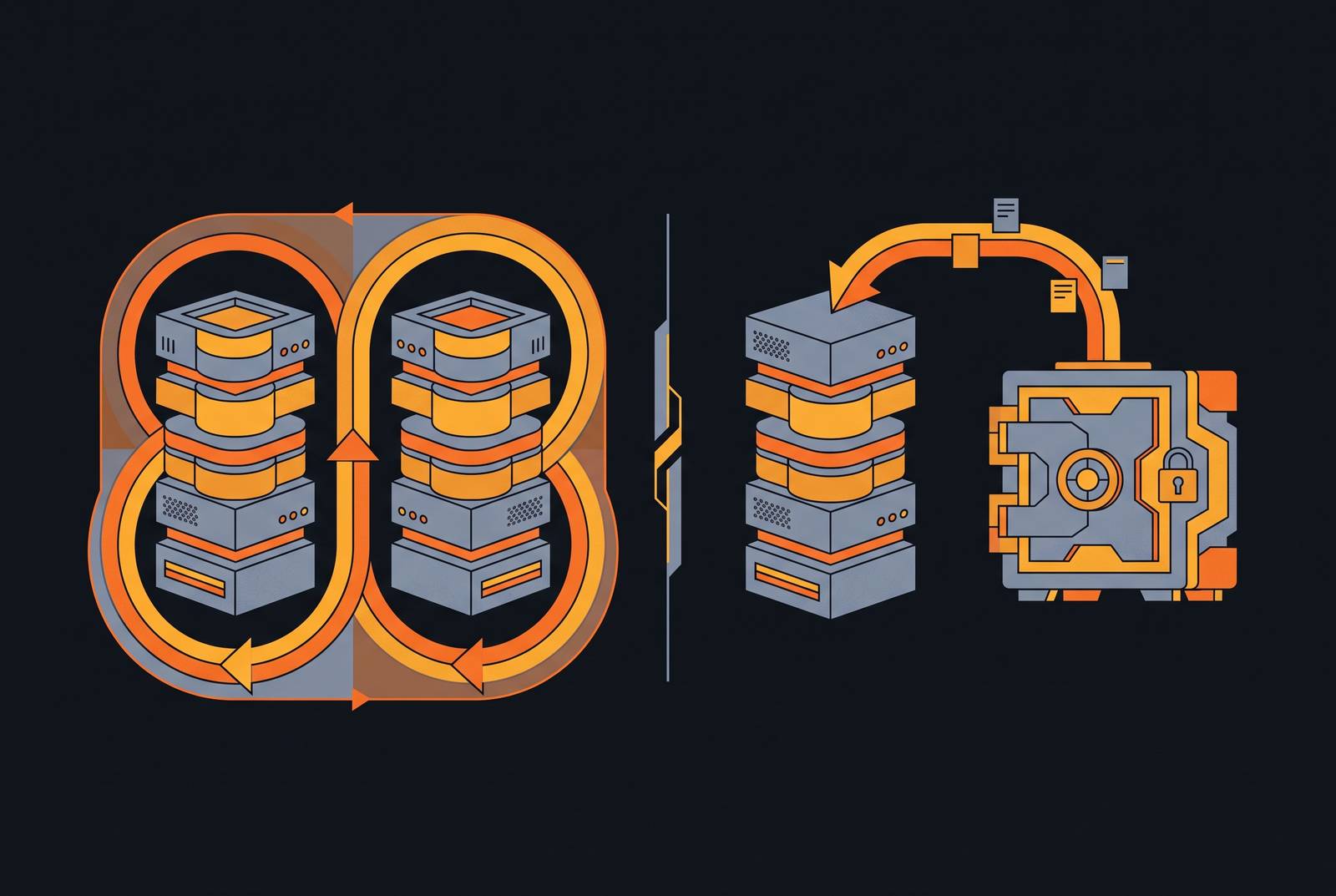
High availability and disaster recovery get treated as synonyms in most client conversations, and that habit is going to cost someone a very bad week. They are not the same discipline. HA keeps a service running when a piece of it fails; DR gets an organization back to a working state after the whole environment, or the data inside it, has been compromised. An agency that conflates the two can watch every uptime dashboard read green while the actual data needed to recover from an incident no longer exists anywhere in the stack.
What high availability requires in practice
HA exists to remove single points of failure so that no individual component fault ever reaches an end user. HA generally requires redundancy across multiple layers: hardware (backup power, duplicated storage), software (clustering, load balancing, self-healing systems that shift load across servers automatically), and environmental (data centers spread across regions or availability zones, so a localized problem stays localized).
Speed is what defines the category. Trilio noted that a load-balanced cluster can fail over to a backup node in milliseconds, and that's the whole point: the failure happens and resolves before a user notices anything changed. The industry's uptime benchmarks make this concrete. A system running at 99.9% uptime tolerates 8.76 hours of downtime a year. At 99.999%, the "five nines" standard, the tolerance drops to 5.26 minutes annually. That's not resilience in the abstract; that's a service agreement someone signs.
HA planning, then, is a specific and bounded exercise: redundancy design, failover paths, health checks, dependency mapping. HA planning leaves out restore runbooks. It leaves the recovery owner unassigned. It does not set an RPO. And that's precisely where the trouble starts, because replication has no mechanism for judging what it's copying. If ransomware encrypts a volume, or someone fat-fingers a delete, or corruption creeps in silently, that bad state propagates across healthy nodes the same way clean data does. The system stays up. It's just up and wrong.
What disaster recovery requires in practice
DR is not HA running on a longer clock, even though people sometimes describe it that way. It's a different discipline entirely, built around recovery windows measured in hours or days rather than milliseconds, and built around a set of artifacts HA planning never touches.
A real DR plan needs restore runbooks, documented and actually tested, not just written and filed away. It needs a named recovery owner, someone with the actual permissions to execute a restore at 2 a.m. without waiting on an approval chain. It needs defined RTO and RPO targets, which the next section unpacks in detail. And it needs backup visibility: knowing, before an incident happens, whether the backups sitting in storage are clean, aligned to policy, and searchable.
Organizations typically choose among cold, warm, and hot DR models, and the choice should follow from business-defined recovery targets rather than whatever the infrastructure team finds easiest to build. Hot DR recovers fastest but demands the heaviest investment and the most ongoing operational care; cold DR costs less and asks the business to tolerate a much longer outage.
There is something structural that explains why DR keeps losing the internal budget fight to HA: HA has a built-in owner because uptime SLAs are visible daily, breach them and someone hears about it immediately. DR ownership blurs because failures in a restore process stay invisible until a test, an audit, a corruption event, or an actual outage drags them into the light. Failover ownership is visible because failures show up immediately, while restore failures stay hidden until a test, an audit, a corruption event, or an actual outage exposes them. A clean failover drill proves nothing about whether the backups underneath it are usable, because a passing failover test and a passing restore test measure entirely different things; agencies should treat them as two separate controls.
For clients running regulated workloads, DR reviews also need to carry the weight of data sovereignty rules and cross-border transfer restrictions, since the location of a recovery environment isn't just a technical decision anymore.
How RTO and RPO translate HA and DR decisions into business terms
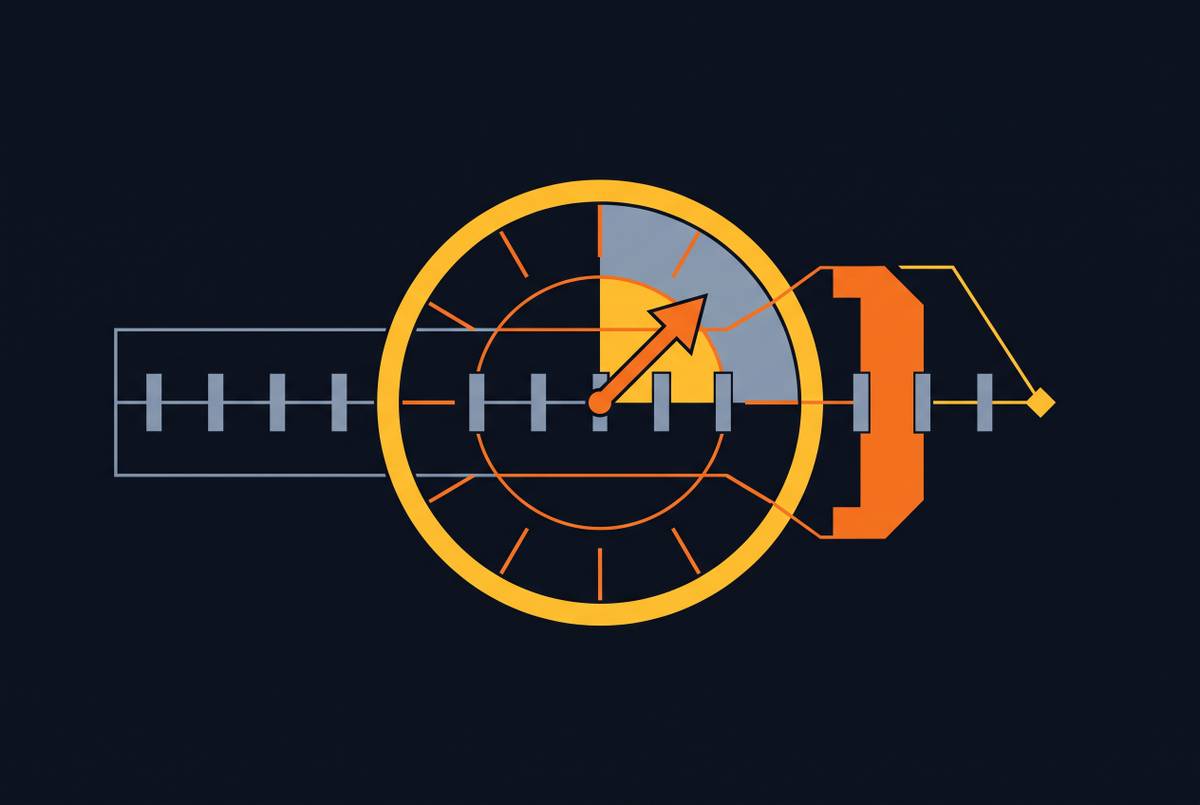
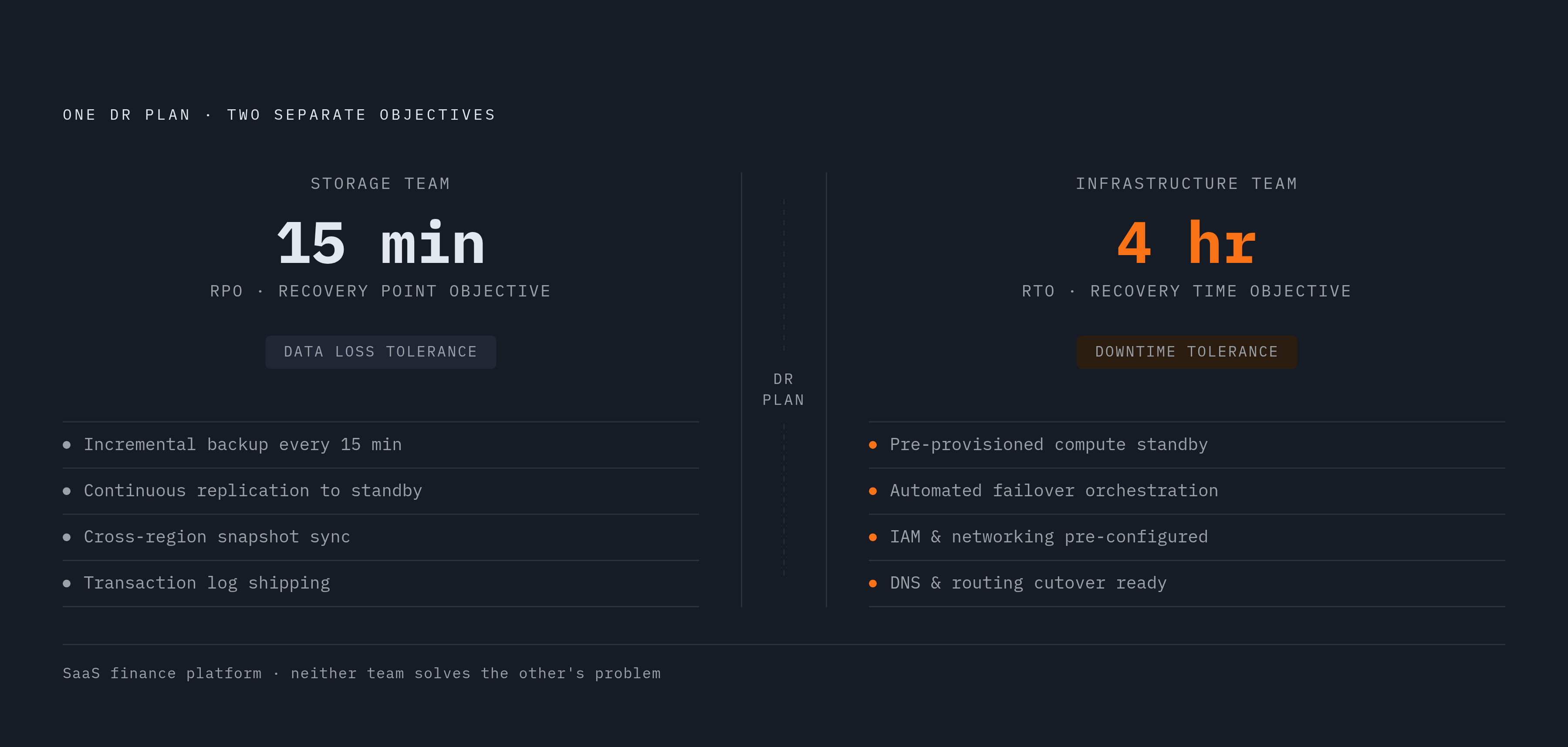
RTO, Recovery Time Objective, is the maximum downtime a business can absorb before the damage turns severe. It's fundamentally an infrastructure question. RPO, Recovery Point Objective, is the maximum data loss a business can tolerate, measured in time, and it's fundamentally a storage and replication question. Different problems, different engineering teams, same DR document.
Picture a SaaS finance platform that sets a 4-hour RTO and a 15-minute RPO. The RPO forces backups to run every 15 minutes, which is a storage and replication decision. The RTO forces pre-provisioned compute, automated failover, and a full environment (IAM, networking, routing, all of it) ready to go inside four hours, which is an infrastructure decision. Both numbers live in the same plan. Neither one gets solved by the same team solving the other.
Tighter targets cost more, and the relationship isn't linear. Chasing a 15-minute RTO costs exponentially more than accepting a 24-hour one, and tightening the RPO requires more frequent backups; more frequent backups increase storage spend. NIST's guidance tiers this by criticality for good reason: mission-critical systems justify mirrored infrastructure, disk replication, and hot sites with recovery measured in minutes; moderate-impact systems can live with warm-site capability; non-critical systems can often tolerate a recovery window stretching anywhere from four to twenty-four-plus hours.
Not every client system deserves near-zero RTO and RPO. Agencies that try to sell that as a blanket standard are either overcharging or padding a proposal, and the smarter move is tiering workloads and spending recovery engineering effort where the business impact actually justifies it. None of this matters, though, if the underlying recovery infrastructure isn't tested. Data from the field bears this out starkly: 37% of organizations cannot recover within their own required RTO because backups are missing or untested. A target on paper is not a target that's been earned.
The failure scenarios where HA works but DR has already failed
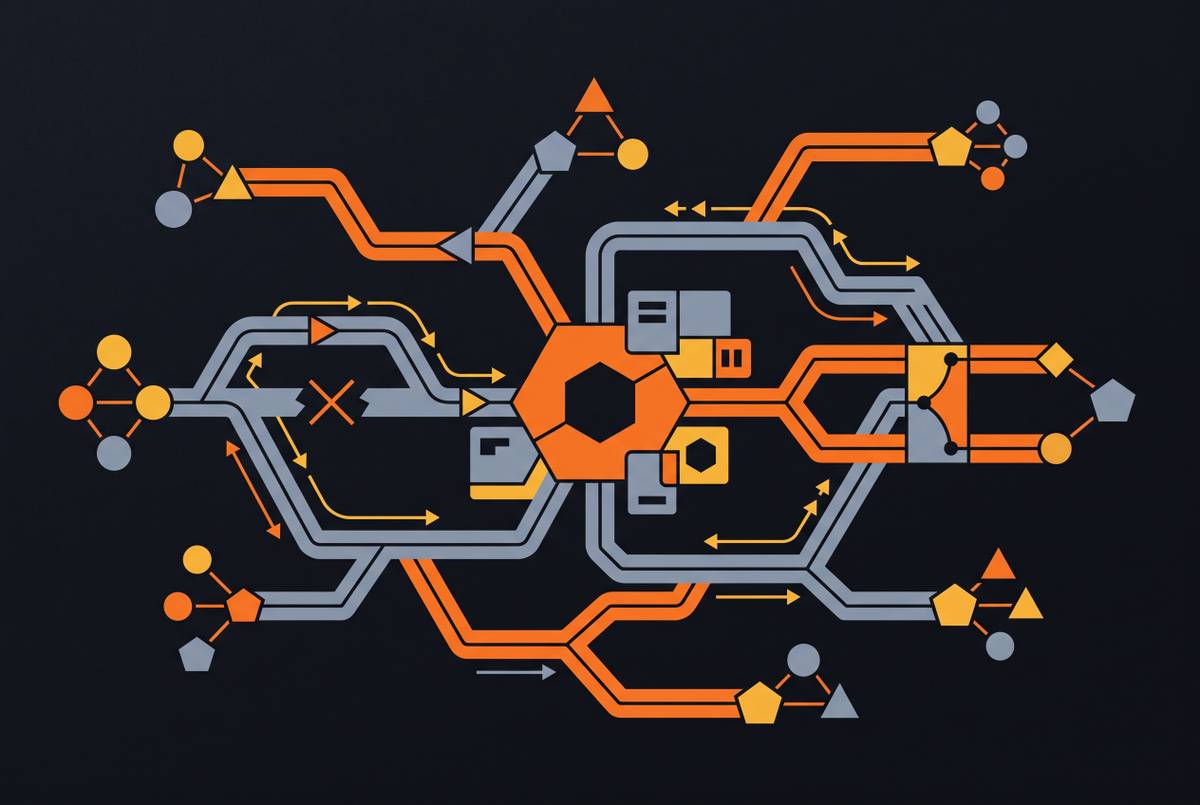
The gap between the two disciplines is invisible right up until it isn't. By the time anyone notices a problem, the compromised state may already be sitting on every healthy HA node in the cluster, replicated faithfully, indistinguishable from clean data at the infrastructure layer. Availability holds. Recoverability is already gone.
Ransomware is the clearest case. Encryption spreads to replicated nodes exactly the way clean data does, because HA has no mechanism for judging what it's copying. It'll keep the encrypted environment running smoothly, which sounds almost cruel once you think about it: the system that's supposed to protect you is now faithfully preserving the attack. Only DR, backed by clean restore points from before the compromise, gets anyone out of that hole.
Accidental deletion works the same way. HA replicates the deletion, not just the data that survived it, so no healthy node anywhere in the cluster retains what was lost. And a region-wide cloud outage exposes a different structural limit entirely: HA failover generally operates inside a single provider's infrastructure, so if the provider itself goes dark, there's nothing left to route traffic to. Recovery in that scenario depends on a separate region or a separate provider entirely, which is DR territory, not HA territory.
The Disaster Recovery Journal's findings put a name on the dominant threat: cyber incidents are now the leading cause of downtime and data loss, ahead of hardware failure. That matters because a lot of continuity budgets were built for a world where hardware failure was the main enemy, and HA was a reasonable answer to that world. It's a much weaker answer to ransomware. Organizations that leaned hard into HA investment while treating DR as an afterthought are, specifically and structurally, unprotected against the threat that's now doing the most damage.
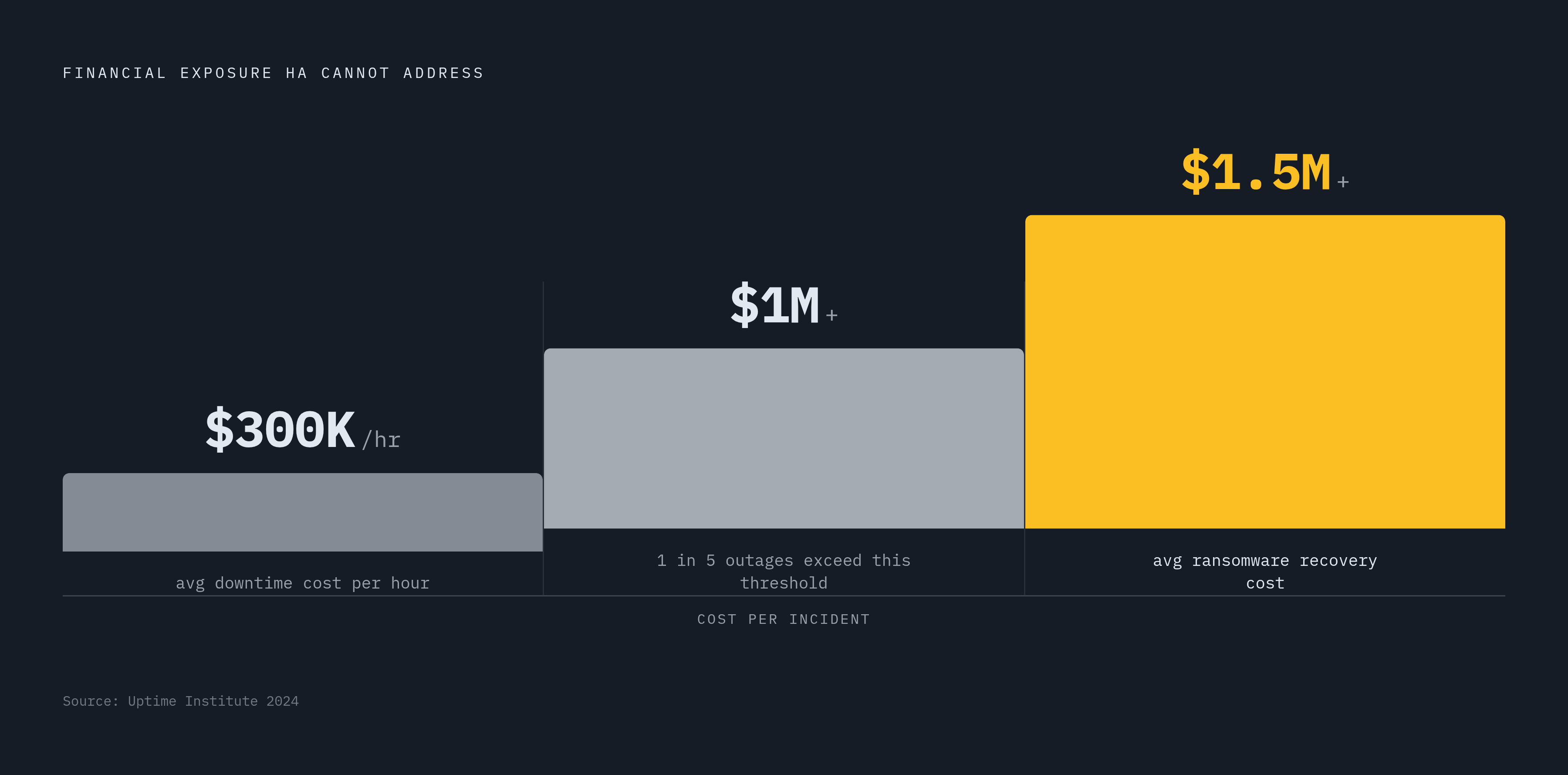
The financial exposure is not abstract. The Uptime Institute's 2024 Global Data Center Survey found that 20% of impactful outages cost more than $1 million, with average downtime running past $300,000 an hour. Ransomware recovery averages north of $1.5 million. Those numbers make the case for rebalancing continuity budgets better than any argument about principle ever could.
A combined HA and DR architecture for client infrastructure
Combining HA and DR means running two layers in parallel rather than merging them into a single system. It means running two layers in parallel, each with its own tooling, its own owners, and its own testing schedule, because collapsing them together is exactly the mistake that got most organizations into this position.
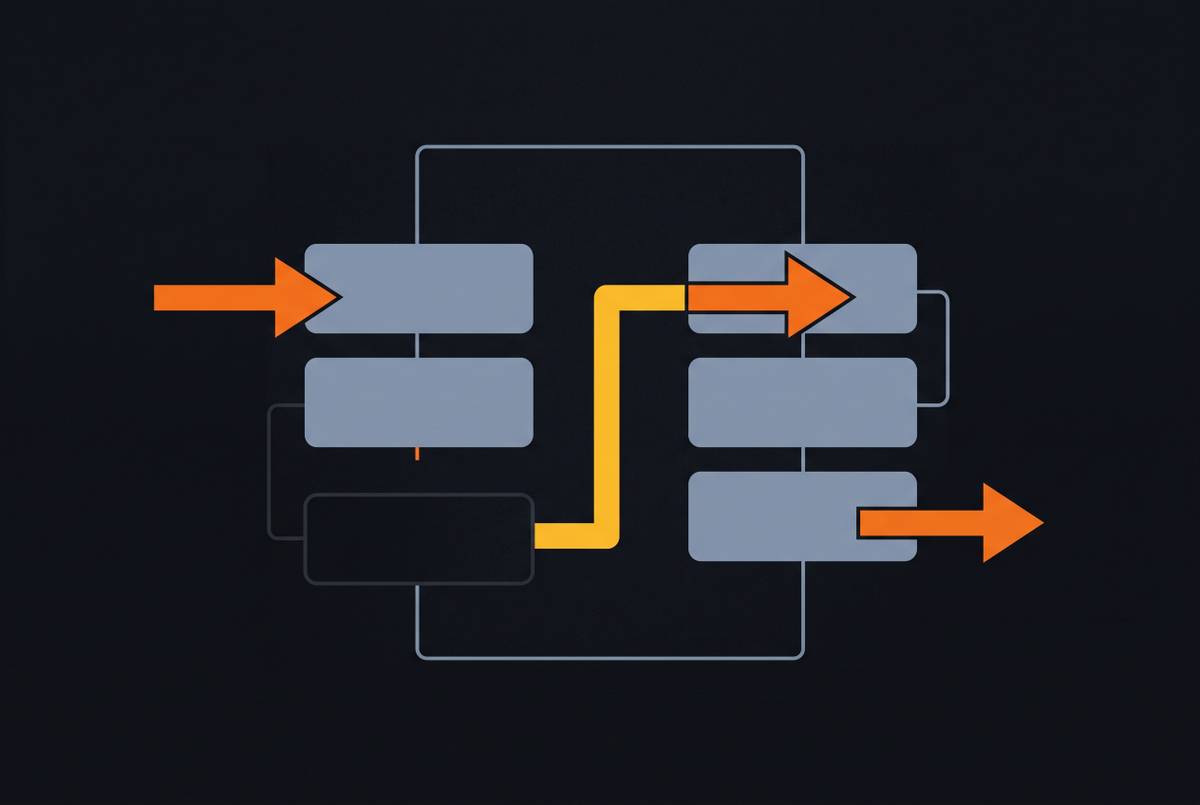
The HA layer covers instance failures, node failures, and zone unavailability, handled through load balancing, health checks, automated traffic shifting, and the hardware and software redundancy described earlier. The DR layer covers data integrity loss, regional outages, ransomware, and serious misconfiguration, handled through clean restore points, documented runbooks, and RTO/RPO targets set in advance rather than improvised during an incident.
The 3-2-1 backup strategy (three copies of the data, on two different types of media, with one copy stored offsite) is the foundation DR sits on, and it is not something HA replication can substitute for, no matter how many nodes are involved. Testing needs the same separation. Failover tests validate the HA layer and tend to happen often, since uptime SLAs make any failure obvious almost immediately. Restore tests validate the DR layer and have to be run as their own distinct control, since a clean failover drill says nothing about whether the backups behind it would actually restore. A DR plan deserves testing at least once a year, and ideally twice, or after any meaningful change to infrastructure, staffing, or the business itself.
For agencies managing several clients at once, the practical move is mapping each client's workloads into criticality tiers and assigning HA and DR specifications per tier, rather than applying one architecture across every account regardless of what it actually needs. And for clients carrying regulated data, the location of the recovery environment and any cross-border transfer restriction needs to be part of the design from the start, not something bolted on after the fact.
How DRaaS changes agency economics for managing multiple clients
DRaaS took the capital cost out of enterprise-grade disaster recovery. Instead of building and maintaining secondary hardware, an organization buys managed recovery delivered as a cloud service, which changes who can realistically afford serious DR and how fast it can be stood up.
The market numbers reflect real demand rather than vendor hype. Fortune Business Insights valued the global DRaaS market at USD 18.89 billion in 2025, with a projection to reach USD 83.15 billion by 2034, a compound annual growth rate of 20.35%. North America held 37.21% of that market in 2025, and public cloud delivery is expected to hold a 35.27% share by 2026, which tells you where the growth is actually landing: cloud-native, not on-premises.
Agencies should read the revenue data as a direct signal. The Kaseya State of the MSP Report found that 50% of MSPs reported year-over-year revenue growth in business continuity and disaster recovery specifically, meaning clients are paying for DR as an ongoing service, not treating backup as a line item they set once and forget. Ransomware is accelerating that shift: Veeam's 2025 Ransomware Trends Report found that 74% of organizations plan to use DRaaS specifically for ransomware recovery by 2026.
Vendor activity backs this up. Microsoft made Self-Service Disaster Recovery available for Finance and Operations applications on June 22, 2026. Cohesity and 11:11 Systems, in an October 2024 partnership expansion, introduced a managed Clean Room Recovery service, an isolated restoration environment designed to cut the risk of reinfection during a recovery process. That's a meaningful detail: recovery environments are now being built with the assumption that the production environment they're recovering from might still be hostile.
An agency that can't explain how HA and DR differ to a client can't do any of this. The tooling has gotten easier to deploy; the advisory gap has not closed on its own. Research has found that 73% of companies remain inadequately prepared for disasters, which is less a market opportunity than a standing liability most organizations are carrying without realizing it.
Structuring client conversations about HA and DR
Uptime and recoverability are governed by entirely different controls and tested in entirely different ways; an agency's first job in this conversation is separating the two for clients, who conflate them constantly.
A short set of diagnostic questions tends to expose the gap fast: Are there documented RTO and RPO targets for each critical system? When were backups last tested for actual restorability, not just confirmed as running on schedule? If ransomware encrypted the production environment today, what's the most recent clean restore point that could be verified? And who, by name, owns DR execution, with the permissions to act on it without waiting for someone else's sign-off?
The budget conversation practically makes itself once the cost asymmetry is on the table. IBM puts the cost of downtime at $5,600 per minute, and the Uptime Institute's 2024 survey found that a fifth of impactful outages cost more than $1 million. Set against those numbers, the cost of a properly tested DR plan looks small, while the cost of an untested one is a bet nobody should be making with someone else's business.
Tiering belongs in this conversation too. Not every client needs five-nines HA paired with hot DR, and walking a client through a criticality exercise, mapping their systems to actual business impact, prevents both the overspend of gold-plating a marketing site and the under-protection of treating a payments system like a blog.
Reporting has to be ongoing, not reactive. Clients should see the state of their HA and DR controls on a set schedule, test results, backup coverage, current RTO/RPO targets measured against the architecture actually in place, rather than hearing about any of it for the first time during an incident. And none of this works if the account team itself can't hold the HA/DR distinction straight in conversation. Training on this is a prerequisite for credible advisory work.
As more of a client's brand presence and content delivery runs through AI-driven infrastructure, continuity for those systems shifts from a purely IT concern to a brand risk. HA and DR planning for AI-facing infrastructure is drifting into the agency's scope of responsibility, even where the contract hasn't caught up yet.