Recovery Time Objective Benchmarks by Industry Vertical
Set your RTO by the damage the outage causes, not what your infrastructure can deliver.
Recovery Time Objective, as NIST SP 800-34 defines it, is the maximum stretch of time a system can stay down before the damage becomes unacceptable to the business it serves. That definition matters more than it looks, because RTO is not a technical guess about server rebuild speed: it's a number derived from harm, and harm looks completely different depending on what industry you're in. Most companies get this backwards. They start with what their infrastructure can deliver and call that the RTO, when the only defensible order runs the other way: name the harm first, then make the infrastructure match it. That reversal, not some shortage of tooling, is the actual reason most continuity plans fail before an incident ever tests them.
Recovery Point Objective rides alongside RTO, governing how much data loss is tolerable rather than how much downtime is tolerable. Treating either one in isolation misses the point of both. A system that comes back online fast but loses an hour of transactions has not actually recovered, it has just relocated the damage from an outage to a reconciliation problem.
How a business impact analysis actually produces an RTO target
A real RTO comes out of a business impact analysis, not a vendor's SLA template. The process starts by naming the mission the system supports, then mapping how harm accumulates as the outage stretches from minutes to hours to days. From there it pulls in contractual and regulatory ceilings, checks how much manual fallback capacity actually exists (can staff process orders on paper for two hours, or does the whole operation seize), and traces the dependency chain underneath the system in question.
Precision in scope is where most RTOs quietly fall apart. A payments RTO of 60 minutes sounds specific until you ask which part of payments it covers. If authorization can fail over in five minutes but settlement takes a full day to reconcile, "60 minutes" was never a real number. It was an average of two very different problems, stapled together and presented as one. A defensible RTO names the capability, the region, the data state, the minimum acceptable capacity, and the condition under which recovery counts as validated, not just technically online.
OneUptime's 2026 analysis frames this as a ladder rather than a single deadline: detect the threat, stop irreversible harm, restore minimum viable capability, restore full service, restore redundancy, then complete reconciliation. Each rung has its own clock, and collapsing the ladder into one MTTR figure hides exactly the information a continuity plan needs. A database might legitimately need a shorter RTO than the customer-facing app sitting on top of it, since the application layer, validation checks, backlog replay, and customer communications all queue up after the data layer comes back. None of it counts unless it's tested. A paper RTO with no restore drills and no verified spare capacity is a document, not a capability.
Financial services: where seconds are regulatory events
Financial services runs the tightest clock of any sector, and for good reason. Core banking systems typically target 15 to 30 minutes, while trading and payment systems push toward seconds to under an hour. The aggression is not vanity. A trading platform outage can produce losses in the millions within seconds, and downtime in this sector can itself constitute a compliance violation, not just a revenue event.
PCI DSS stacks fines on top of the lost transactions themselves, with penalties ranging from $5,000 to $100,000 per month. RPO rides alongside all of this at a similarly tight threshold for core banking functions, because a fast restart that loses an hour of ledger entries solves nothing. The number is not negotiable downward based on what infrastructure costs, either. Regulation hands you the target in this sector, and cost of compliance is simply the price of admission. Any firm treating it as a line item to optimize has misread what the requirement is actually for.
Healthcare: patient safety as the binding constraint
Healthcare RTOs run looser on paper, 30 minutes to two hours for most clinical systems, with life-critical monitoring aiming for something close to zero through real-time backup and cloud redundancy. RPO tightens to under 15 minutes for patient-critical data, because an electronic health records system that loses an hour of entries before a surgical case is a patient-safety failure. It's a patient safety incident.
Consider what a "2-hour RTO" actually looks like in practice. The EHR goes dark at 2:47 in the morning; by six, doctors across three facilities are working off paper charts, and orders that would normally route through a decision-support system are handwritten instead. That's the operational reality behind the stated number, and it's why even systems that look like back-office functions, scheduling and billing, cascade into patient-facing harm once the outage runs long enough.
The gap between the stated target and what actually happens under ransomware is where healthcare's numbers turn uncomfortable. TotalAssure's 2025 analysis, drawing on 3,400 IT professionals across 17 countries, found organizations averaging 24 days of actual recovery after a ransomware attack, with healthcare recovery timelines running even longer. Twenty-four days against a stated RTO of two hours is a severe gap, driven largely by the patient-safety validation that has to clear before any clinical system gets cleared to come back online. No amount of tooling closes a gap that wide. Only slower, verified restoration does, and that means the two-hour figure was never describing what happens under attack, only what happens when the hardware behaves.
E-commerce and retail: every minute is a transaction decision
Retail and e-commerce RTOs for customer-facing systems during peak season are typically aggressive, with longer windows tolerated for back-office functions once the calendar turns quiet. That uneven treatment is deliberate. RTO varies across a retail organization rather than being a single number, it's a schedule that shifts with the season, and any retailer applying a flat target year-round is either overspending in January or underprotected in November.
The financial case backs up the seasonal split. E-commerce and retail downtime costs run well above the cross-industry average, and large retailers face steep per-minute losses. Consumer behavior enforces the target more than any regulator does, with a large majority of consumers abandoning a retailer after hitting errors, and that reputational cost outlives the outage itself by a wide margin.
A four-hour outage in February and the same outage during the last week of November are not the same event financially, even though the stated RTO reads identically on paper. Any retail RTO tested only against average-day traffic is, by definition, untested for the day it matters most. A "four-hour RTO" isn't satisfied by the storefront reloading, either. It requires all revenue-enabling systems back within that window, since a site that loads but can't take a payment has recovered nothing.
Manufacturing: when physical processes set the clock
Manufacturing RTOs run 1 to 4 hours for production-critical systems, tighter for safety and quality-control functions, considerably looser for administrative systems that don't touch the line. What makes manufacturing distinct is that the clock doesn't stop when the system comes back. A four-hour outage on a just-in-time production line doesn't produce four hours of loss, it produces days of restabilization once the physical process has been interrupted, because machines don't resume mid-cycle the way a web server does.
A 2024 report found 55% of mid-sized Ontario manufacturers experienced outages averaging 8.7 hours from IT failures alone, well past most stated targets. A separate simulation found that server shortages alone could stretch recovery times 48% beyond the original estimate, which says something about how thin the margin for error gets once physical capacity enters the picture. Ransomware recovery in the sector has stretched well beyond most stated targets, with recovery times and costs running higher than cross-industry averages, per TotalAssure's 2025 dataset, another wide gap between the paper target and the lived one.
Manufacturing also makes the tiering problem hardest to ignore. OT and production systems, the ERP layer, and email inside the same plant can carry entirely different RTOs. A single headline recovery number for "manufacturing" tells you almost nothing about any specific system on the floor, and anyone quoting one figure for a whole plant is either simplifying for a slide deck or hasn't looked closely enough.
Non-critical and internal systems: where longer RTOs are a rational choice
Not every system deserves a tight RTO, and treating them all the same produces the worst of both outcomes rather than a safe middle ground. Email typically gets a longer window than revenue-critical systems, since an email outage doesn't translate into lost revenue the way a payment system or a production line does. Systems that are genuinely non-critical can rationally carry an RTO or RPO of 24 hours or more. The business impact analysis hasn't changed here, only the harm calculation feeding it has.
Applying one uniform recovery standard across an entire organization leaves the most critical systems under-protected while the least critical ones absorb budget they don't need. A customer-facing SaaS platform, for comparison, often lands around a four-hour RTO with a 15-minute RPO: tighter than an internal tool, looser than anything in banking or healthcare, calibrated to whatever SLA the company has actually promised its customers rather than to a regulator.
The gap between stated RTOs and actual ransomware recovery
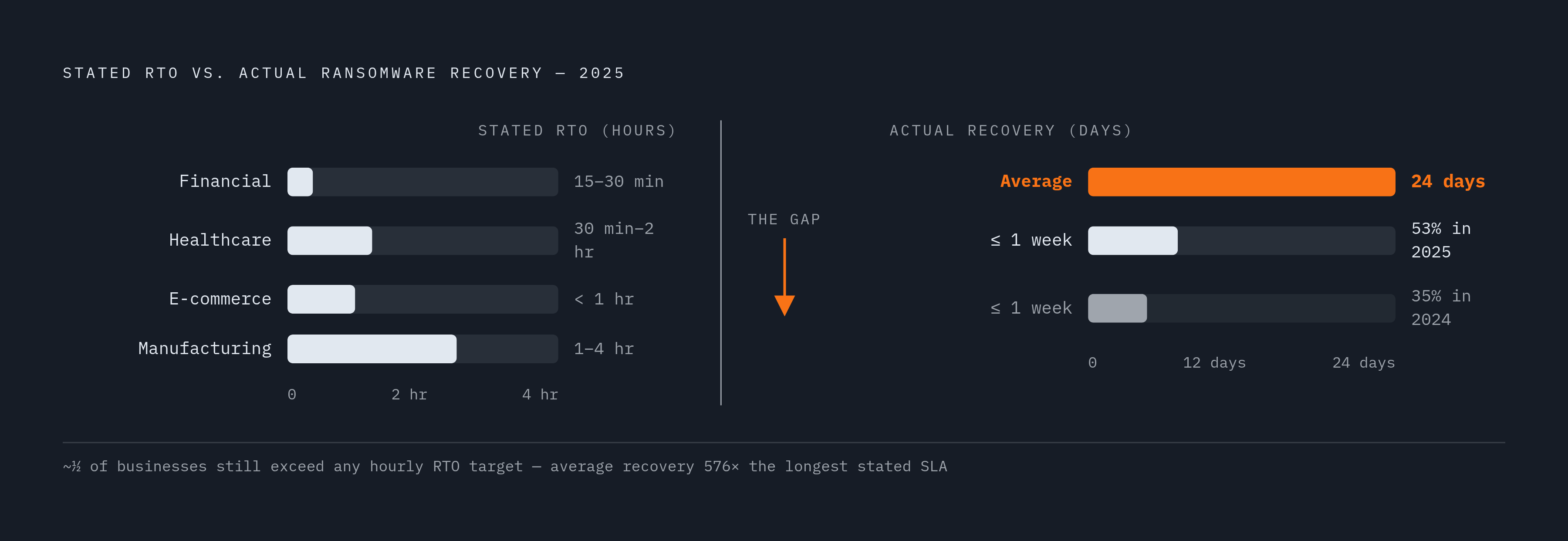
Stated RTOs are measured in hours across almost every sector discussed so far. Actual ransomware recovery in 2025 averaged 24 days, according to TotalAssure's survey of 3,400 IT professionals across 17 countries. That gap is the single most important fact in this entire discussion, because it means most organizations are planning against a scenario their own recovery plan has never been tested against. An RTO stated in hours and a recovery measured in weeks are not the same plan wearing different clothes. They are two different claims, and only one of them has been through an actual incident.
Attackers have compressed their own timeline too. The median time from initial intrusion to ransomware execution now sits at just five days, leaving far less warning before the event that starts the RTO clock in the first place. Progress is real but partial: 53% of businesses recovered within a week in 2025, up from 35% in 2024, which still leaves roughly half of all organizations recovering well outside any RTO measured in hours.
Automation is where the gap starts closing, and the mechanism is specific rather than vague. Organizations running automated incident-response playbooks cut containment time from 79 days to 51, a 35% reduction. Those pairing immutable backups with automated recovery workflows brought average recovery down from roughly 31 days to 14, per TotalAssure's 2025 findings. Size complicates the picture further: organizations above 10,000 employees averaged 38 days to recover, while those under 50 employees averaged 18. Complexity, not just budget, drives the timeline, and a bigger organization is not automatically a faster one. Anyone assuming otherwise is confusing resources with readiness.
A stated RTO is only as real as the last restore test performed against it. Anything untested is a hope dressed up as a plan, and the ransomware recovery numbers are the proof, not a footnote to it.
How to read your sector's benchmark and set a target that holds up
Industry benchmarks work as a sanity check, not as a substitute for doing the work. Sound RTO methodology holds that a target has to reflect the specific customer journey, legal exposure, fallback capacity, and cost of downtime behind it, none of which an industry average can supply on its own. Anyone who sets a target straight off a benchmark table has skipped the business impact analysis entirely and is hoping the sector median covers for it. It won't, and the healthcare and manufacturing numbers above are the receipts.
Every RTO needs to name its terms precisely, covering the capability, the region, the data state, the minimum required capacity, and the condition that counts as validated recovery. A single number attached to a complex system is, at best, incomplete. Build the milestone ladder instead of a single deadline (detection, containment, minimum viable capability, full service, redundancy, reconciliation), with each rung carrying its own target set by whatever requirement is most demanding.
Then test it against reality rather than intention. Track achieved recovery during game days and real incidents, and report the share of incidents that actually hit each milestone rather than leaning on an average MTTR that flatters the good months and buries the bad ones. An average recovery time under 30 minutes can sit comfortably next to several severe breaches that blew past every target the organization ever set, so tail performance deserves at least as much scrutiny as the mean, arguably more.
None of this is static. Traffic patterns shift, architecture changes, fallback capacity erodes or improves, and business impact moves with it, so RTO targets need version history and dated annotations rather than a single number set once and left alone. For agencies and firms managing infrastructure across multiple clients, the same tiering logic scales up: knowing where each client's business actually sits on this spectrum, financial services against internal tooling, healthcare against retail, is the starting point for recovery commitments that survive contact with an actual incident.