Immutable Backup Storage for Ransomware Defense
Attackers now target backups first, making immutability the difference between recovery and ransom.
Ransomware has stopped being a smash-and-grab crime and turned into something closer to a siege. Attackers now spend days mapping a network before they trigger anything, and the first target on their list is often the backup system rather than the finance server or the customer database. This piece walks through why that shift changed everything about how recovery works, what "immutable" actually means once you get past the marketing copy, and why the gap between organizations that recover cleanly and those that pay up now comes down to a handful of specific, checkable engineering decisions.
Start with the playbook, because it explains the rest. A modern ransomware crew gets in, sits quietly, and uses credential-harvesting tools like Mimikatz or frameworks like Cobalt Strike to find admin accounts. Once they have those, they go looking for backup servers, NAS boxes, and snapshot directories, and they delete or encrypt Volume Shadow Copies before they ever touch the production payload. Only after the backups are gone or unusable does the actual encryption event happen. According to Sophos's 2024 State of Ransomware research, 94% of ransomware attacks attempted to compromise backups, and 57% of those attempts succeeded. That's the whole game in two numbers. An organization with working backups can just restore and walk away, so taking away that option is the precondition for getting paid. A backup that can be deleted by whoever breaks in offers only limited protection, functioning as a second target sitting right next to the first one.
The financial gap between organizations whose backups survived and those whose didn't
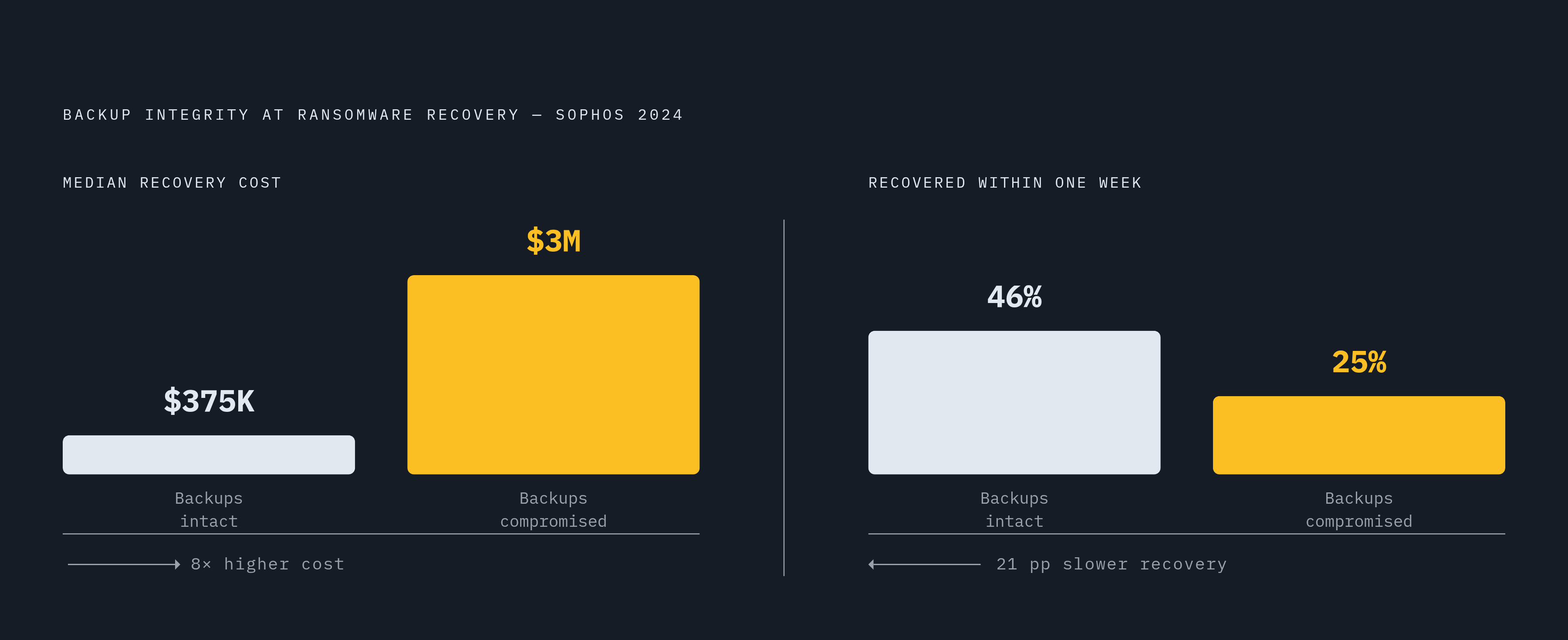
The headline split, per the same Sophos research: median recovery cost of $3 million when backups were compromised, versus $375,000 when they stayed intact. That's an 8x difference, and it shows up in speed too, not just dollars. Organizations with intact backups recovered within a week 46% of the time. When backups were compromised, that number dropped to 25%.
Paying the ransom doesn't fix this either. Fortinet has reported that 80% of organizations that pay are attacked again within twelve months. The median ransom payment in 2025 was $1 million, a price tag that, at best, buys a coin flip on getting usable data back.
What's encouraging, if anything here can be called that, is the trend line: 53% of victims fully recovered within one week in 2025, up from 35% the year before. Backup infrastructure explains that shift more than negotiating skill or payment processing speed does. Organizations closing the recovery gap are restoring faster because the attackers never got a hand on the copy that mattered. So the natural next question is mechanical: what actually makes a backup untouchable, in a technical sense, rather than untouchable in a slide deck?
What immutability actually means at the storage layer
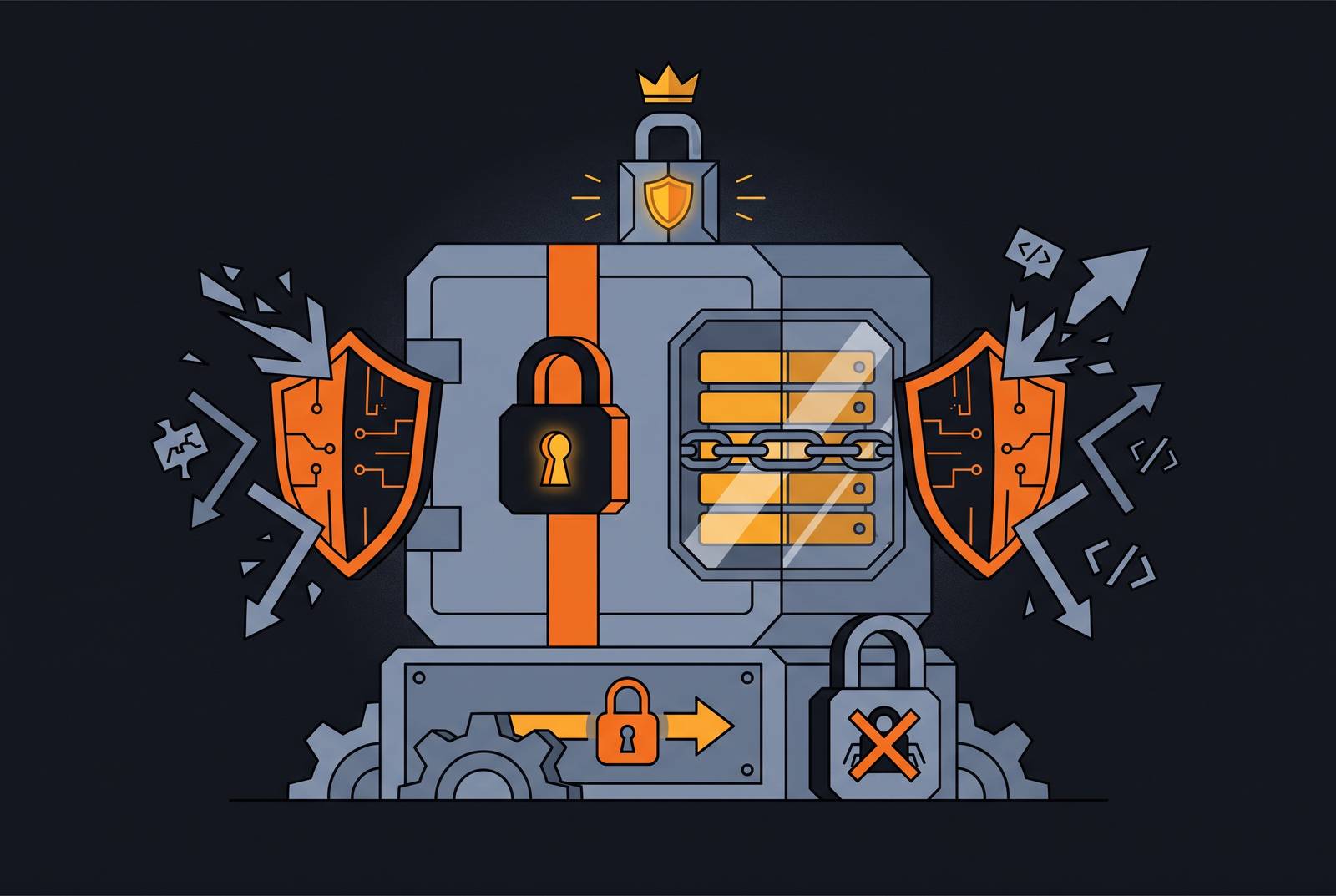
Immutability means a backup cannot be changed, deleted, or encrypted for a set retention period, and that holds true no matter who's asking, including someone holding valid domain admin credentials. That last part is the whole point. Conventional security protects data by controlling who has the keys. Immutability protects data by making the lock irrelevant to who holds the keys at all, because the restriction lives in the storage layer itself, below the level where credentials operate.
The underlying idea is WORM: Write Once, Read Many. It's an old concept, going back roughly fifty years to physical media like optical discs, where a laser burns data in a way that simply cannot be rewritten. There's no permission system to bypass because the physical medium itself doesn't support the operation. Modern software-defined storage recreates that same guarantee without needing physical media: object storage or file systems mark data as unchangeable through metadata, and any write or delete request against that metadata gets rejected at the system level, not the access-control level.
Worth separating the two terms here, because vendors blur them constantly. WORM is a storage property. Immutability is an outcome someone has to architect for on purpose, and a system can technically support WORM while still leaving gaps that make the "immutable" backup perfectly reachable. The practical upshot, when it's done right: the protected copy sits in a state an attacker's toolchain has no path to, because the relevant door doesn't exist at that layer at all.
The main implementation approaches and what each protects against
Five approaches show up in practice, and each one trades off differently.
Hardware WORM, mainly LTO tape, writes data once onto physical media that can't be altered afterward. It's solid for compliance retention and long-term archiving, though restoring from tape is slower than pulling from disk, so it's rarely the first recovery tier anyone reaches for.
Object Lock, and similar software-defined WORM features across many cloud and on-prem platforms, enforce immutability through metadata rather than hardware. Amazon S3's version of this splits into governance mode and compliance mode: governance mode can be overridden by someone with sufficient admin rights, while compliance mode locks retention so that even an administrator can't shorten it. The catch that trips people up: a locked copy sitting in the same account as production is still inside the same blast radius. If the attacker owns the account, the lock is a formality. The safer setup puts the locked copy in a separate account that production credentials simply cannot administer.
Air-gapped storage means genuine network disconnection, offline copies that ransomware physically cannot reach because there's no network path to reach them through. The tradeoff is restore speed, and the gap has to be real. A "logical" air gap that still shares a credential plane with production offers a lot less protection than an actual physical or network disconnect.
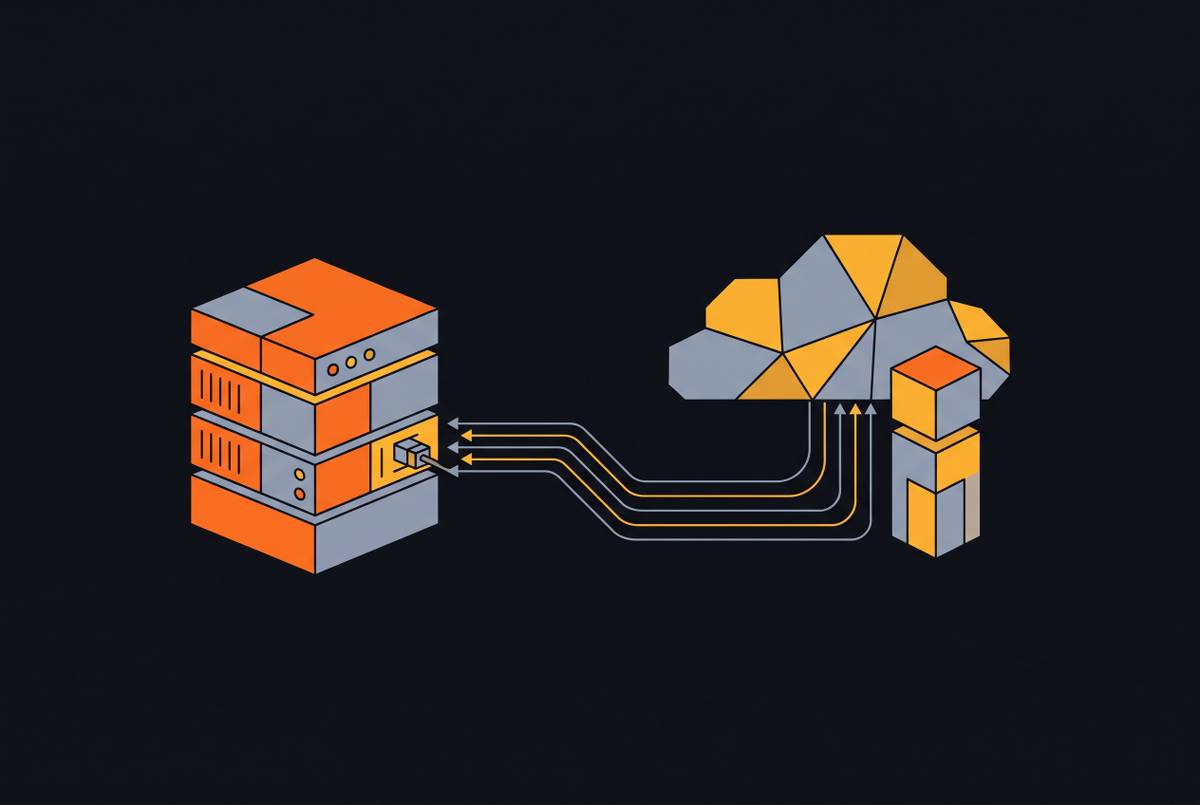
Cloud immutable backup uses remote servers with object-level locking on a pay-as-you-go model. AWS, GCP, and Azure each offer native immutable object storage with encryption and MFA layered on top, and putting that copy in a different geographic region from production adds resilience beyond the immutability itself.
Blockchain-augmented immutability stores each backup event as a cryptographically linked block, creating a chain-of-custody trail. It's less about recovery speed and more useful in regulated industries where proving data integrity to an auditor matters as much as the restore itself.
Across all five, the same principle decides whether any of it actually works: the administrative plane managing the immutable copy has to sit apart from whatever administrative plane the ransomware can reach. Everything else is implementation detail on top of that one requirement.
How the 3-2-1-1-0 rule extends the classic framework to cover an adversarial threat model
The old 3-2-1 rule says: three copies of your data, on two different media types, with one copy offsite. It's a good rule, built for a world of disk failures, accidental deletions, and the occasional flood or fire. What it doesn't account for is an attacker who can reach the offsite copy simply because it shares credentials with everything else.
3-2-1-1-0 adds two things. The second "1" requires that at least one copy be immutable, unchangeable for a defined window regardless of who has admin access. The "0" stands for zero errors, meaning automated, scheduled verification that every backup actually restores. A backup nobody has tested is only a plan on paper.
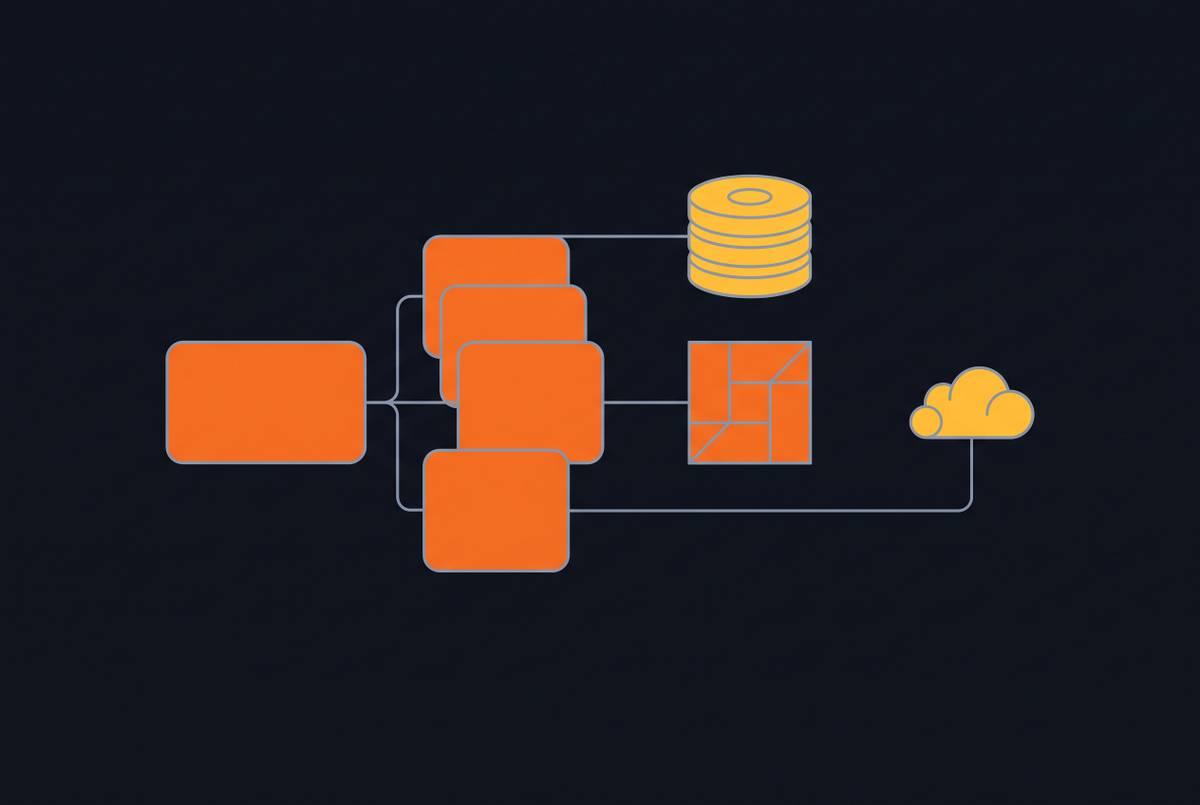
That "0" changes behavior in practice. It pushes organizations toward regular restore drills, pre-assigned incident response roles (who calls whom, who flips which switch), and monitoring tuned to catch an attack in progress before encryption finishes. A workable three-tier setup for a mid-sized organization might look like this: fast local disk backups for everyday restores, an immutable object-locked repository as the primary ransomware recovery tier, and an air-gapped tier, offline tape or an isolated cloud vault, as the last resort that's genuinely unreachable from the production network.
The bigger point buried in the acronym: 3-2-1-1-0 represents a genuinely different threat model, a broader shift than a minor patch on top of 3-2-1. The original rule assumed hardware fails randomly and people occasionally hit delete by mistake. This one assumes there's an adversary on the other end actively drawing a map of your recovery path.
Where immutable backups fit inside a broader layered defense — and what they don't replace
Immutability guarantees recovery. It does not prevent an attack, and it does nothing to stop ransomware from encrypting production data in the first place. What it does is give an organization a clean copy to restore from once every other control has already failed, which is a narrower job than people sometimes assume it does.
It works alongside endpoint detection and response, which catches ransomware behavior before encryption completes; network segmentation, which slows lateral movement toward the backup infrastructure in the first place; privileged access management, which narrows the window where stolen credentials are useful; and vulnerability management, which matters more than it used to. The Verizon 2026 Data Breach Investigations Report found vulnerability exploitation drove about 31% of incidents, up from 20%, which makes patching a direct input into whether backups survive at all, not a separate IT hygiene task.
The credential principle applies specifically to backup administration too. Backup admin accounts shouldn't sit in the same credential store as production admin accounts. MFA belongs on the backup management console, and any attempt to shorten or delete a retention lock should trigger an out-of-band alert, something outside the normal ticketing system an attacker might also control.
Here's what makes immutability distinct from every other item on that list: it's the one control that still works after an attacker already has admin access. EDR, segmentation, PAM, all of it can be disabled or bypassed by someone holding the right credentials. Immutability, enforced at the storage layer, cannot be turned off by a login, because there's no login path to the switch.
Implementation decisions that determine whether an immutable backup is genuinely safe
The failure mode that matters most: immutability that looks solid on paper but isn't in practice. A locked copy sharing an account, a region, or a credential plane with production sits inside the attacker's reach whether or not the word "immutable" appears in the vendor's documentation. Governance mode on an object lock can be loosened by an admin, and if the attacker has admin rights, governance mode buys nothing. Compliance mode removes that option entirely, which is the whole reason it exists.
Retention period matters more than it sounds like it should. It has to outlast the attacker's dwell time, and given that attackers may sit inside a network for days or weeks before triggering the payload, a retention window that's too short means the lock has already expired by the time anyone notices the breach. Too long, and storage costs climb without buying additional protection, so the number should match realistic detection timelines rather than a round figure someone picked because it sounded safe.
For cloud setups, account separation isn't optional. The immutable copy needs its own account, separate billing, separate identity and access management, with no cross-account role that a production workload could assume to reach it.
Verification closes the loop. Automated restore testing on a fixed schedule, not an occasional spot check, and an alert on any change to lock settings or retention configuration. The organizations that recovered in under a week shared two things in common: tested backup plans and incident response roles defined ahead of time, not improvised during the breach.
Encryption of the immutable copy itself is a separate requirement from immutability, and both matter. Immutability stops deletion. Encryption stops an attacker who reaches the storage layer from reading what's inside it. Skip either one and the other doesn't fully cover for it.
The practical test, stripped down: if an attacker had every credential in the production environment, could they touch the backup copy? If the honest answer is yes, "immutable" is only a label there, not a property that actually holds up.
How improving backup practice is already shifting the ransom payment dynamic
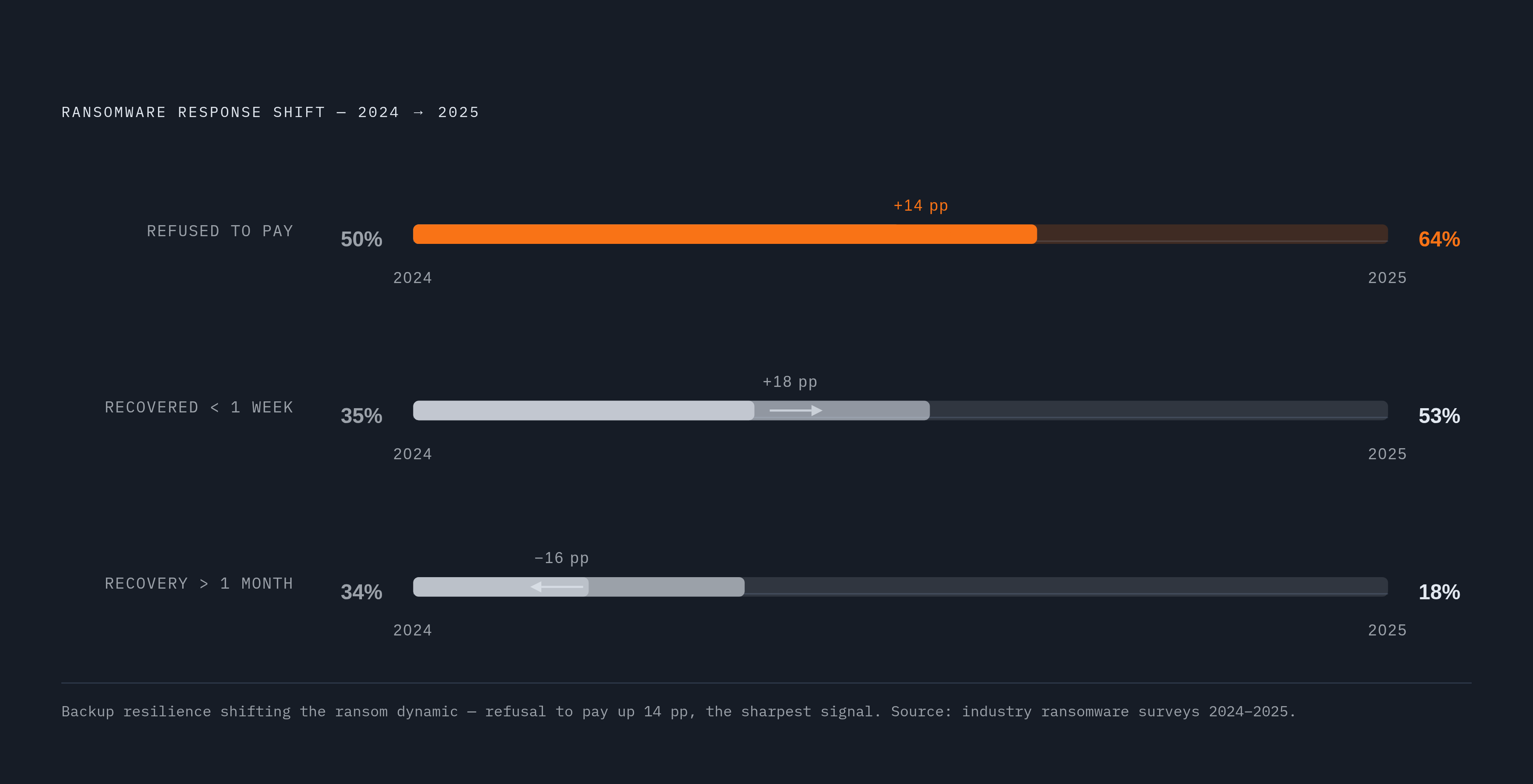
The direction of travel in 2025 is visible in the numbers. 64% of victim organizations refused to pay ransom that year, up from 50% two years earlier, a shift that tracks directly with better backup and recovery capability rather than any change in negotiating posture. 53% of victims fully recovered within a week, up from 35% in 2024. Only 18% took more than a month to recover, down sharply from 34% the year before.
The mechanism isn't mysterious. Organizations investing in tested, immutable, credential-isolated backup infrastructure are the ones pulling those averages upward. And there's a pricing logic underneath it: ransom demands scale with the attacker's read on how desperate the victim is to get data back. As immutable backups spread, that leverage shrinks. Median demanded ransom fell from $2 million in 2024 to a median payment of $1 million in 2025, roughly half.
None of this means the threat is fading. Ransomware still accounted for 48% of breaches per the Verizon 2026 DBIR, and the growth in vulnerability exploitation as an entry point, from 20% to 31%, points to attackers finding new ways in even as old ones close. The improvement sits entirely on the recovery side of the ledger, not the attack-frequency side.
Which leaves a fairly durable takeaway: ransomware will keep going after backups, because backups remain the single most reliable way for a victim to say no. The organizations building recovery infrastructure that's genuinely, mechanically untouchable aren't just avoiding a ransom payment. They're changing the question at the center of the whole incident, moving from "how much do we owe" toward "how fast can we be back online" — a far better position to be in when a breach hits.