DR Plan Documentation Standards for Audits and Insurance

A long list of frameworks now carry explicit DR documentation requirements: NIST SP 800-34, NIST SP 800-184, ISO 27001, SOC 2, HIPAA, DORA, NIS2, PCI DSS, FedRAMP, NIST RMF, NIST 800-53, GDPR, and CMMC among them. Each wants something slightly different in writing, and organizations subject to more than one have to satisfy all of them at once. Picking the easiest framework and hoping it covers the rest is the single most common mistake in this space. It doesn't survive contact with a real audit, and it shouldn't.
NIST SP 800-34 treats the DRP as one of eight types of information system contingency plans and builds a seven-step contingency planning process around it. The Business Impact Analysis is Step 2, covered in Section 3.2, and it functions as the analytic engine behind the entire plan, not a preliminary exercise to clear before the real work starts. NIST SP 800-184 adds another layer on top: organizations have to maintain a current list of every person, process, technology asset, and data set required to resume mission or business processes. That inventory is what makes priority tiers and recovery sequencing auditable instead of aspirational.
SOC 2 addresses availability through a specific set of Trust Service Criteria. CC9.1 covers business disruption risk mitigation, including BCP and DR planning and testing. A1.2 covers environmental protections: software, data backup processes, recovery infrastructure, power, fire suppression, temperature control. A1.3 requires that recovery procedures actually get tested. Auditors working from these criteria ask for three things specifically: the plan document itself, test results showing actual RTO and RPO measurements, and evidence the plan was reviewed within the last twelve months.
ISO 27001, under Annex A 5.29, requires that organizations plan how to maintain information security at an appropriate level during a disruptive situation. It reads as a shorter requirement than SOC 2's, but auditors still expect it backed by a real plan, not a policy sentence sitting alone on a page.
DORA, which took effect across the EU on January 17, 2025, applies to banks, insurers, investment firms, and a broad range of other categories of financial entities, along with critical ICT third-party providers and, indirectly, nearly all their vendors. Article 11 requires developing and testing ICT continuity plans. Article 24 requires operational resilience tests at least once a year. Entities formally designated by their competent authority, typically the largest and most systemically important firms, must also undergo threat-led penetration testing. A September 2024 paper from the ECIIA notes that DORA directly requires internal audit to review ICT response and recovery plans on a regular basis, with auditors who are appropriately skilled to do it, and a follow-up process that verifies critical findings actually get remediated. Even where internal audit doesn't author the penetration test itself, the results still have to be documented in a qualitative report.
HIPAA expects evidence of contingency planning. GDPR expects evidence of data restoration capability. Neither accepts a policy statement in place of documented proof, and both will ask for the artifact, not the assurance.
Different frameworks weight different proof points, and that's the part organizations underestimate. NIST and DORA care most about the BIA and the asset inventory. SOC 2 cares most about the testing record and the review cadence. HIPAA and GDPR care most about data restoration evidence. An organization sitting under multiple frameworks has to build one set of documentation that answers to all of these emphases at once. That's harder than it sounds, and it's exactly where most DRPs start showing cracks.
What the Business Impact Analysis must establish before the rest of the plan can be written
Both NIST SP 800-34, Section 3.2, and DRII Practice 3 treat the BIA as the analytic engine of recovery planning. Treating it as a formality to clear before the "real" planning starts gets the order backwards: the BIA is the real document, and every later page only says what the BIA allows it to say.
A BIA has to establish which business processes are actually mission-critical, and why, in terms specific enough to survive a challenge. It has to quantify the business impact of each process being unavailable across multiple dimensions, tracked over time rather than at a single moment. It has to map dependencies too: the people, technology assets, and data each process relies on. From all of that, it derives the Maximum Tolerable Downtime for each process, the number from which RTO and RPO targets get built.
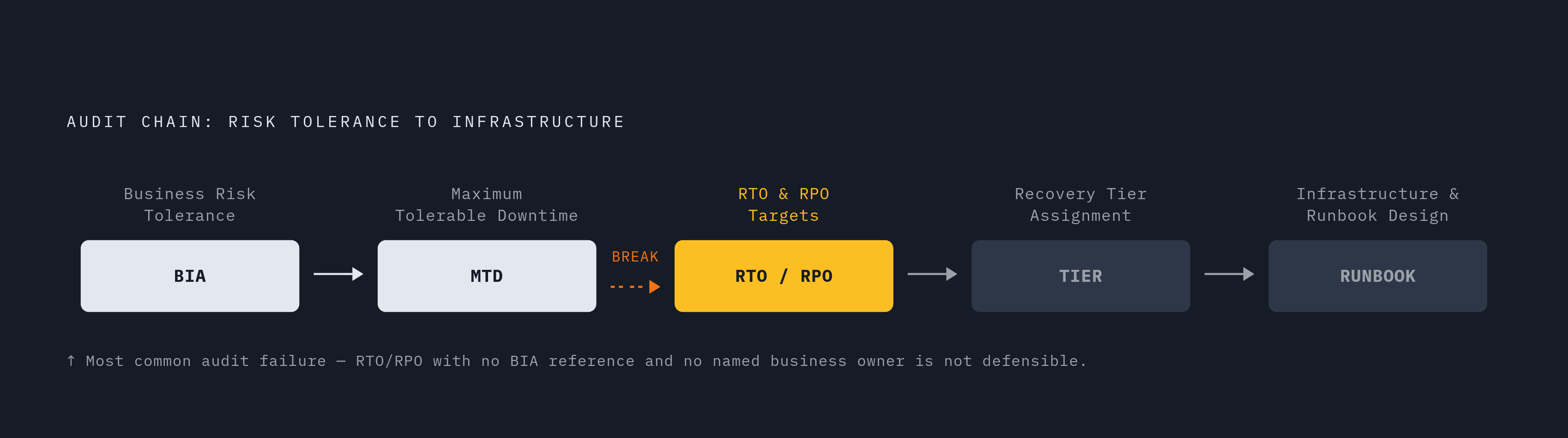
Auditors follow a specific chain when they review this. Business risk tolerance from the BIA leads to MTD, which leads to RTO and RPO targets, which leads to recovery tier assignments, which leads to infrastructure and runbook design. If any link is missing, or exists but can't be traced back to the one before it, the whole structure fails under scrutiny. A polished runbook means nothing if nobody can show where the RTO number came from.
The most common failure here is depressingly ordinary. RTO and RPO values get set by IT based on what the infrastructure can deliver, rather than by business owners based on what the organization can actually tolerate, and that's backwards. ISO 22301 and NIST SP 800-34 both anchor target-setting in business risk tolerance, full stop. So when an auditor asks who signed off on a given RTO, and whether that sign-off traces back to a BIA with documented impact thresholds, a number with no named business owner and no BIA reference behind it is not defensible. It's a guess with a decimal point attached.
NIST SP 800-184's requirement to maintain a current list of people, processes, and technology assets needed for recovery is the operational expression of the BIA, and it can't be a one-time exercise filed away after the initial audit. Assets change, staff change, vendors change. A stale inventory is functionally the same as no inventory once an auditor starts asking about current state.
The four cloud DR strategies and how recovery tier assignments translate into auditable architecture
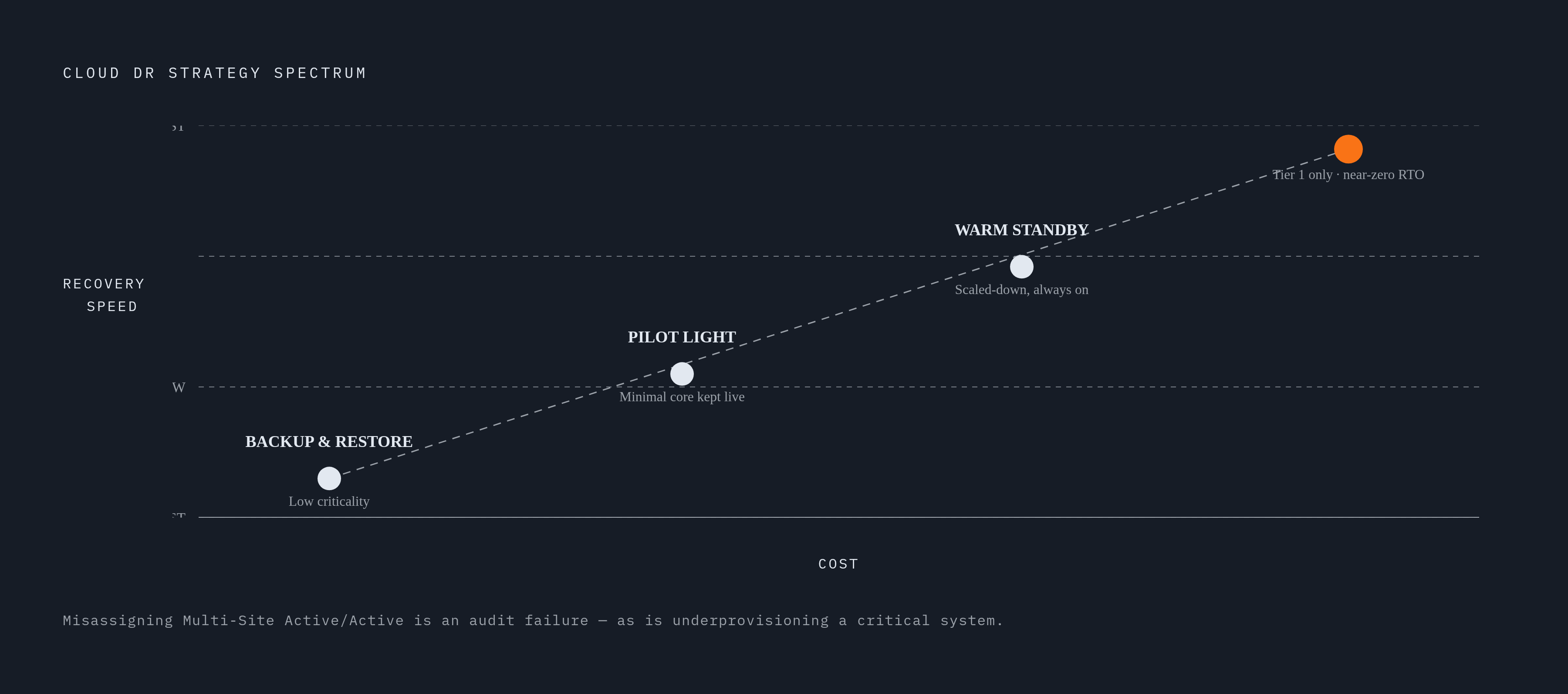
Cloud DR strategies sit on a spectrum between cost and recovery speed, and there are four canonical options. Backup and restore is the cheapest and slowest, appropriate for low-criticality tiers where a long outage is annoying but not existential. Pilot light keeps a minimal core of infrastructure running at all times, ready to scale up when needed. Warm standby runs a scaled-down version of the production environment continuously, narrowing the gap to full capacity. Multi-site active/active delivers near-zero recovery time at the highest cost, and it belongs only on Tier 1 workloads with the most aggressive RTOs, the ones where every minute of downtime carries a dollar figure attached to it.
Assigning multi-site active/active to a system that doesn't need it is just as much a failure as underprovisioning a Tier 1 workload. It's money spent chasing a resilience target the business never asked for, and auditors examining architecture documentation look at whether each system's assigned tier actually matches the RTO and RPO the BIA derived, whether the chosen strategy is technically capable of hitting the stated RTO at all, and whether infrastructure dependencies are actually mapped out. A warm standby environment that depends on a third-party DNS provider is only as resilient as that provider's own uptime, and if the documentation doesn't acknowledge the dependency, the resilience claim is incomplete.
Network diagrams matter beyond the audit context too. Cyber insurance underwriters commonly request network documentation as part of the application process, which means the same diagrams built for DR architecture review can serve double duty on the insurance submission. That's an efficiency worth building into the documentation process from the start, rather than redrawing the same network twice for two different reviewers.
Third-party risk carries its own weight under DORA specifically, which imposes requirements around ICT third-party service provider oversight and risk management. Documentation of provider dependencies and their contractual recovery commitments belongs inside the audit scope itself, not off to the side as a procurement task disconnected from the DR team.
Where most organizations' documentation actually breaks down is the gap between the target and the justification. They'll write down an RTO. They'll write down a strategy. What's missing is the technical reasoning connecting the two: why this architecture, at this tier, can actually deliver the number written above it.
Testing records: what format, frequency, and measurement auditors will accept
SOC 2's A1.3 doesn't just require that recovery procedures exist on paper. It requires that they be tested, and the test record itself counts as a first-class audit artifact, not a supporting exhibit tucked behind the main document.
Frameworks converge on a minimum cadence: annual testing at minimum for a full DR audit, more frequently for Tier 1 workloads given how much rides on them. DORA requires operational resilience tests at least once a year, and entities formally designated by their competent authority layer threat-led penetration testing on top, with results captured in a qualitative report.
A test record only counts as auditable if it captures specific things: the date and scope of the test (which systems, which scenario), the actual RTO and RPO measured during the test rather than the targets written in the plan, what succeeded and what failed, the remediation actions taken afterward, backup completion and failure rates tracked over time rather than a single snapshot, and evidence that restore paths were validated at a granular level. That last one means someone confirmed specific files or records could actually be pulled back, not just that a backup job completed and a checksum matched.
SOC 2 auditors ask specifically for evidence the plan was reviewed on a regular cadence, and that review has to be documented with a date and a named reviewer attached. A review that happened but wasn't logged might as well not have happened, from an audit standpoint.
The testing gap is the most persistent failure mode in DR planning, full stop. Coverage gaps cause more recovery failures than any single technical issue does. Testing, recovery point validation, and granular restore path checks are consistently the items organizations skip, and consistently the ones they regret skipping once a real incident forces the question. Plenty of DR plans check the audit box on paper but would fail under the pressure of an actual outage, because the box-checking exercise and the real-world resilience test were never the same thing.
There's a shift on the insurer side here. Carriers are moving away from taking an organization's word for it and toward demanding screenshots and exports pulled directly from RMM or PSA tools. Test records built in an exportable, shareable format end up serving two masters at once, the auditor and the underwriter. That's reason enough to standardize the format now rather than later.
Communication plans and runbooks as audit artifacts, not operational afterthoughts
A runbook is a step-by-step procedural document detailed enough that any qualified team member could execute it without the original author standing over their shoulder. Auditors assess runbooks against that exact standard: specific enough to follow under pressure, not generic enough to be safely ignored. "Restore database from backup," with no backup location, no named restore tool, and no verification step afterward, is a checklist item mistaken for a runbook. It's a checklist of hopes wearing a runbook's title.
Communication plans get the same scrutiny. Auditors and insurers expect templates covering internal audiences (the executive team, the board, legal, HR) and external audiences (customers, regulators, the cyber insurance carrier, any incident response retainer already under contract). These templates need to exist before an incident starts, because drafting a regulatory notification while the incident is still unfolding is how organizations miss legal deadlines.
DORA adds legal weight here by requiring notification to competent authorities for major ICT incidents. HIPAA expects evidence that affected parties can be notified within its required timeframes, which makes the notification template itself compliance evidence, not a courtesy extended after the fact.
DR audit checklists reflect this scope directly: coverage, RTO and RPO targets, recovery testing, runbooks, communication plans, and compliance evidence all sit on the same list. A missing runbook or an absent communication template draws real scrutiny, logged as a finding the same way a missing backup test would be, not waved through as a minor gap.
What all of this really demonstrates is whether an organization has thought through the human coordination a disaster requires, not just the technical steps. That distinction separates a plan written to survive an audit from a plan written to actually work when the systems are down and people are waiting on answers.
What cyber insurance underwriters check in 2026 and how it maps to DR documentation
The global cyber insurance market is projected at $16.3 billion for 2025, and a market that size has industrialized its underwriting process accordingly. Carriers no longer take an applicant's description of their controls at face value. Self-attestation alone is no longer sufficient going into 2026, and any DR documentation built around a promise instead of a proof point will get bounced back.
Carriers want screenshots, exports pulled from RMM or PSA tools, and evidence that controls have actually been tested, not a form with boxes checked. Marsh McLennan's 2024 report found that 41% of applications get denied on first submission. A denial rate at that level turns documentation quality into a commercial variable that affects premium and coverage availability directly, not a compliance formality sitting off to the side.
The application package itself asks for network diagrams, security policies, training records, vendor agreements, incident response plans, and evidence of the security tools actually deployed. For policies above $1 million in coverage, underwriters verify a specific set of controls, including phishing-resistant MFA on privileged accounts and remote access, endpoint detection and response, a documented incident response plan, annual penetration testing, and tested backups with evidence that can actually be checked rather than merely claimed.
Ransomware drives most of this scrutiny. It accounted for a large share of cyber insurance losses in the first half of 2025, and Verizon's 2025 DBIR links ransomware to 75% of system-intrusion breaches. That's why MFA, EDR, and backup documentation sit at the top of nearly every underwriting checklist. The loss data points directly at the controls that would have stopped it.
Business email compromise is the other major driver. Coalition's claims data shows 58% of claims in 2025 involved BEC and funds transfer fraud. At this point, the DR documentation standard and the insurance underwriting standard have effectively merged into one requirement: prove the plan exists, prove it was tested, and prove the numbers in it came from somewhere real. Anything short of that is a gap, and finding gaps is exactly what auditors and underwriters are there to do.