Ransomware Recovery Steps for MSP-Managed Clients
MSPs need a coordinated playbook to contain ransomware before it spreads across clients.
A ransomware incident inside a managed service provider is never bounded to one organization, and that is why MSP recovery needs a different playbook than any in-house IT team ever had to build. In-house IT defends one network. An MSP's technicians hold shared RMM agents, PSA integrations, API keys, and delegated admin into dozens of customer Microsoft tenants at once, and that one-to-many access model produces the structural risk: a single compromised credential or tool can reach every client tenant it touches. CISA, the NSA, and the MS-ISAC gave a warning in January 2023: threat actors can exploit these trust relationships in MSP networks, so a single compromise can reach many of a victim MSP's customers at once. The Kaseya VSA attack in July 2021 remains the clearest demonstration: REvil exploited multiple zero-day vulnerabilities in Kaseya's software, including an authentication bypass and an arbitrary command execution flaw, to push ransomware through the MSP layer into somewhere between 800 and 1,500 downstream businesses by Kaseya's own count. The vector has not gone quiet since. In 2025, the DragonForce group compromised an MSP's SimpleHelp remote monitoring and management tool and used it to deploy ransomware across multiple client endpoints while also pulling sensitive data out the door. What makes the MSP's position different from an internal IT department's is not just exposure. The MSP has to respond to the incident, account for the possibility that its own tooling was the entry point, and keep advising the client as the trusted party managing that client's infrastructure, all three roles held at once. Modern ransomware operators run multi-stage intrusions that combine encryption with data theft, so restoring files from backup settles only part of the problem even when it works cleanly. The MSP is responder, potential entry point, and trusted advisor all at once, so every step in the recovery sequence that follows carries obligations that in-house IT simply does not face.
The Declared Incident Threshold and Named Incident Commander
The first failure in most ransomware responses has nothing to do with technology. Two or three technicians start working the same compromised tenant on their own, and none of them keeps a shared record of what the others have already touched. You fix that by writing down a trigger threshold before any incident happens, so no one argues over severity at the moment speed matters most. Mass encryption on two or more hosts, a client reporting inaccessible files with a ransom note, or a sudden fleet-wide backup failure should all trip the same declared response, and no one needs to debate whether it qualifies. Once that threshold trips, one person becomes incident commander, one person keeps timestamped notes, and one person owns communication with the client, and the commander does not touch a keyboard. That division can look like unnecessary overhead for a small shop running lean, but it is what separates a defensible record from a forensics firm trying to reconstruct, days later, what changed and in what order from a pile of partial logs. An out-of-band communication channel has to go live the moment the threshold trips, because if the primary systems are encrypted, the response team cannot coordinate over the same infrastructure the attacker is sitting inside. None of this works if it gets improvised in the moment. Response authority, recovery time objectives, recovery point objectives, and communication procedures all need to be defined before an incident ever happens: who has the authority to isolate a network segment, what the escalation path to legal counsel looks like, how a DFIR retainer gets activated. You need that documentation next to the asset inventory, written down and ready, not drafted under pressure while a client's files are already encrypted. The severity matrix, the carrier's claims number, the policy number, and the carrier's panel requirements belong in the same runbook as the network diagram, filed together because they get needed together.
How to isolate affected systems without destroying the forensic evidence you will need later
In the first hour of a ransomware incident, containment and evidence preservation pull in opposite directions. The fastest way to stop an infection from spreading is to power down every affected machine immediately, but powering a machine down erases the memory contents that would otherwise explain how the attacker got in. CISA's ransomware response guidance resolves the tension with a specific sequence: identify which systems were affected, isolate them immediately, and only power a device down if it cannot be disconnected from the network some other way, because memory disappears the moment the machine shuts off. That memory holds the loader, the injected process, and the staging paths the operator used to move through the environment. Lose it, and there is no way to tell the client's insurer how the intrusion actually happened, a gap that tends to get paid for out of the MSP's own margin. Before any machine gets reimaged, disk and memory need to be captured on a sample of the affected devices, because reimaging the first compromised host destroys the only copy of the initial access evidence that exists. Isolation itself works better through a console or an agent than through someone physically pulling network cables: endpoint detection and response tools with one-click containment can quarantine a host while keeping it reachable for evidence collection. Isolation also has to extend past the network layer. Compromised accounts need to be suspended and active sessions revoked, because an attacker who is moving through stolen credentials keeps moving even after every cable in the building is unplugged. The containment perimeter should reach third-party vendors and external tools connected to the environment too, not stop at the internal network segments. All of this depends on the documentation built in the previous stage. Without it, a tired technician under pressure to get a client back online will reimage patient zero before anyone captures the image, and that evidence is gone for good.
How to determine whether the incident is contained to one client or has spread across the MSP's portfolio
The instinct at the start of an incident is to work the ticket in front of the team, the one affected client who called in. The correct move is to check every other tenant immediately, because the tools that make an MSP efficient are the same tools that let one compromise become a portfolio-wide event without the attacker doing anything extra. A shared administrative account, a common RMM agent running across every client, PSA integrations holding API keys, delegated admin into customer Microsoft tenants, and a single backup appliance serving dozens of organizations: each of these turns a single intrusion into a multi-client incident the moment it's touched. Scoping that exposure is arithmetic performed against data that either exists or doesn't. If EDR telemetry only retains seven days of history and initial access happened three weeks earlier, no number of analyst hours recovers an answer that was never logged. Centralized log collection and retention, decided long before any incident starts, is what separates a defensible timeline from a guess presented to a regulator after the fact. Exfiltration should be assumed until it can be ruled out, not the other way around. Double extortion is now the standard operating model for ransomware groups, so if nothing has posted on a leak site, that proves nothing, because operators often sit on stolen data for weeks before they publish it. Cross-tenant checks should look at egress volume against each client's normal baseline, at archive utilities showing up where they have no business running, and at cloud storage destinations turning up in proxy logs. Cross-tenant visibility tools and tested role separation matter here because the same access that lets a technician see across every client's environment can also let an incident spread faster if it isn't properly segmented during containment. Automated isolation adds a genuine trade-off to this stage: high-confidence detections can trigger automatic containment, but how aggressively that automation fires should scale with detection confidence, the criticality of the asset involved, and the client's own authorization, because isolation that fires too broadly can knock healthy tenants offline for no reason. The City of St. Paul's ransomware incident in July 2025 shows what can happen when exfiltration doesn't get this kind of attention early. The city refused to pay Interlock and restored its systems from backup, and it said secure backups let it restore data access without paying a ransom. Interlock had already stolen the data, and it published 43 gigabytes of it publicly in August 2025 while the city's restoration was still underway. Backup restoration brought systems back online. It did not undo the fact that stolen data was already public.
In the first hour of a ransomware incident, containment and evidence preservation pull in opposite directions.
Why the insurance carrier must be notified before an external forensics firm is engaged
The legal and insurance track runs alongside the technical response from the first hour of an incident, not after containment wraps up, and getting the order of operations wrong here has direct financial consequences for the MSP. Most cyber insurance policies require notice to the carrier within a defined window, and most require that forensics and legal counsel be drawn from the carrier's approved panel. If a preferred incident response firm comes in before the carrier signs off, the client's entire cost recovery can be put at risk. The sequence that protects the client is simple: call the carrier before calling the forensics firm. In the alternative sequence, the carrier pays the invoice, then asks why its panel was bypassed, and that conversation typically ends with the MSP absorbing costs the client assumed insurance would cover. That's why the carrier's claims number, policy number, and panel requirements need to sit in the client's runbook next to the network diagram, ready to use, rather than tracked down for the first time in the middle of an incident. Notification obligations don't wait for a recovery outcome. If data left the environment, regulatory and contractual notification duties run on their own clock, no matter what is happening on the technical recovery track. IBM's 2024 Cost of a Data Breach findings show that victims who involved law enforcement saved close to a million dollars in breach costs on average compared to those who didn't, and 63% of ransomware victims who involved law enforcement were able to avoid paying a ransom. The FBI and CISA both advise against paying. Payment doesn't guarantee data recovery, it doesn't close the initial access path the attacker used, and it leaves the organization exposed to a repeat attack through the same hole. If a small business faces closure without a ransom payment, the decision is no longer technical but existential, and an MSP advising in that moment carries a different kind of weight than it does in a routine recovery. That reality doesn't make payment a default recommendation. It makes law enforcement engagement, with its documented track record of reducing both cost and the odds of paying at all, the better path whenever the business can survive the alternative.
How to validate that backup recovery points are clean before initiating any restoration
Backup validation and backup restoration are two different steps, and collapsing them into one is how organizations reinfect themselves right after a successful recovery. Restoring from a compromised or attacker-modified recovery point puts the infection right back into the environment, so proof that a given recovery point is clean has to come before any restore begins, not after. Before data recovery starts, you need to verify directly that the backups are intact and accessible, and confirm the ransomware hasn't already compromised them. Attackers go after backup infrastructure deliberately: they disable backup agents, delete recovery points outright, and quietly modify backup configurations, either to make recovery impossible or to guarantee that a restore brings the malware back with it. The architecture that defends against this is known as the 3-2-1-1-1-0 principle: three copies of the data, on two different media types, with one copy offsite, one copy isolated or immutable, and zero unverified restores. Immutable, offline, and air-gapped describe three distinct controls, and a backup that is immutable isn't automatically offline or air-gapped as well. Each one needs to be checked on its own. The incident team's job at this stage is to confirm that the selected recovery point predates the compromise, not just that the backup job completed without error, because a backup job that ran successfully after initial access can already contain attacker-modified files or a planted persistence mechanism. Clients, regulators, and cyber insurers increasingly expect documented proof that restores actually work, that immutable copies genuinely exist, and that the team can execute a recovery under real incident conditions. A statement that "backups are running" no longer counts as evidence of protection. The recovery point under consideration should be scanned in isolation before it ever touches production, restored in an isolated environment, and have its dependencies rebuilt in order with the application validated before it goes live, and the team should record the recovery point objective and recovery time objective actually achieved, not simply whether the backup job ran.
The correct order of restoration: identity and infrastructure dependencies before applications and user data
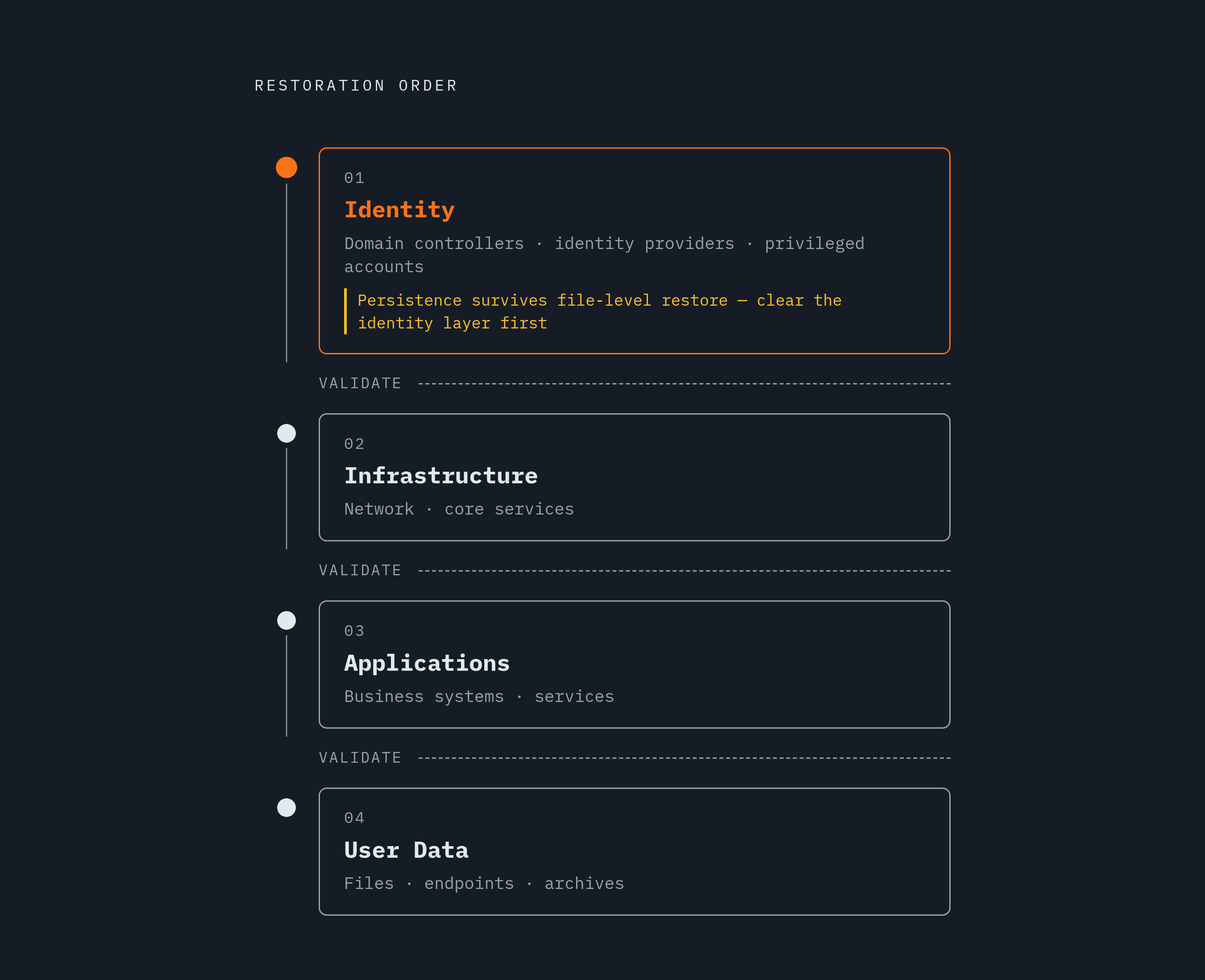
A validated, clean recovery point only does its job if it gets restored in the right order, and the order that matters most is identity and infrastructure first, applications and user data after. If you restore user data before the identity and infrastructure layers underneath it, systems come back online looking functional but still reachable by the attacker, because persistence mechanisms planted in the identity layer survive file-level restoration untouched. A domain controller, an identity provider, or a privileged account that still carries an attacker's backdoor doesn't get cleaned by restoring the documents and databases that sit on top of it. The correct sequence runs identity, then infrastructure, then applications, then data, each layer validated before the next one goes live on top of it. That order reflects how dependencies actually stack in a real environment: applications depend on infrastructure, infrastructure depends on identity, and skipping ahead to user data because it's what the client is asking for first only rebuilds the same compromised foundation under a fresh coat of paint.
Sources
- From Backup Restoration to Minimum Viable Factory Recovery: A Systematization of Ransomware Recovery in Manufacturing Systems
Informed the discussion of backup validation, clean recovery points, and the layered restoration sequence for ransomware recovery.
- Microsoft Incident Response ransomware approach and best practices
Provided the recommended restoration order — identity and infrastructure before applications and user data — used in the final section.
- Cyber Insurance Requirements: Contracts, Regulators, and Carrier Demands
Informed the section on carrier notification requirements, approved panel obligations, and the financial consequences of bypassing insurer procedures.