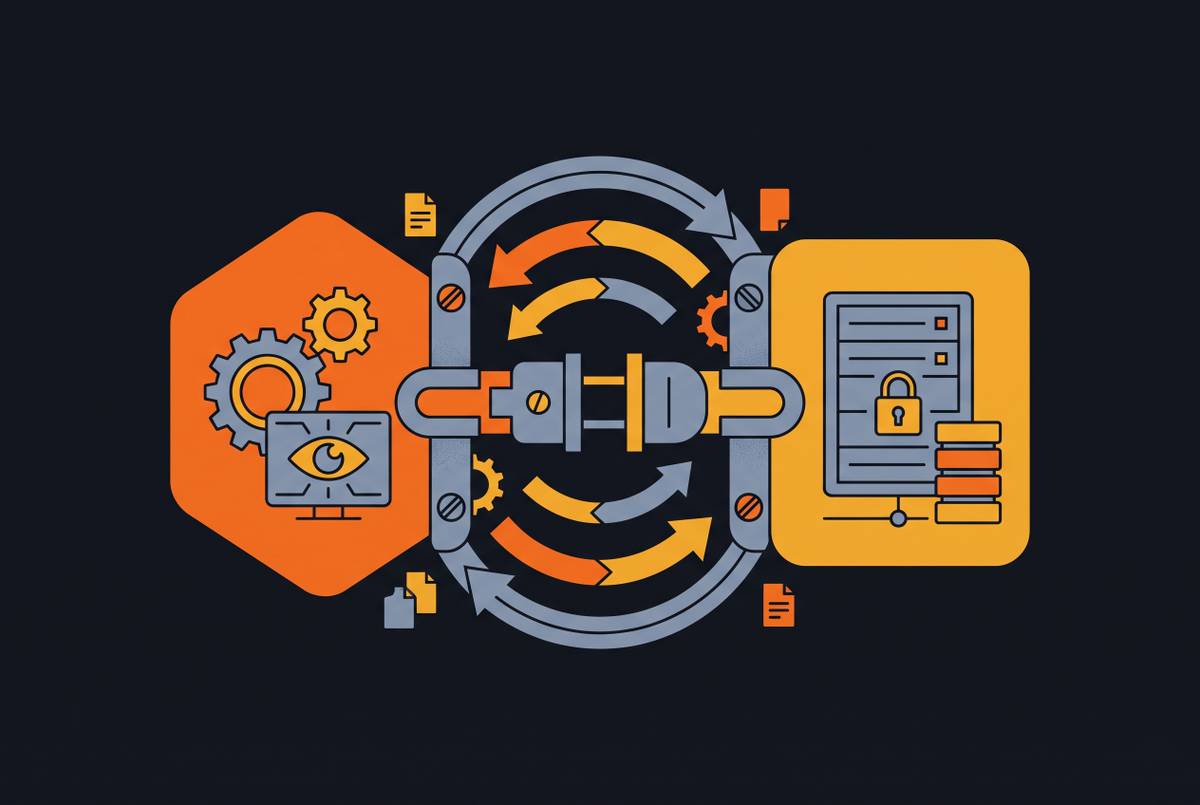
Backup Vendor Contract Red Flags for MSPs
Understand what vendors hide in backup contracts before you sign away your exit strategy.
Backup vendor lock-in rarely announces itself through a technical limitation. A vendor-written term an MSP cannot exit, a fee nobody mentioned during the sales cycle, or data that cannot be retrieved on the MSP's own timeline reveals the lock-in. A small number of platform vendors now dominate the backup market for MSPs, so each of them has a strong incentive to stretch commitment cycles and bundle products together. The contract is the tool that makes those incentives hold.
MSPs who have been burned by a vendor switch tend to describe the same arc: the platform worked fine until something changed, a client's compliance requirement shifted, a workload stopped fitting the platform, a recovery approach needed updating, and only then did the contract reveal what it actually said. That sequence points to a simple fact about leverage. You need to read a backup vendor contract closely before you sign it, because once it is signed, the vendor's incentives and the MSP's no longer point the same way.
Auto-Renewal and Notice-Window Clauses
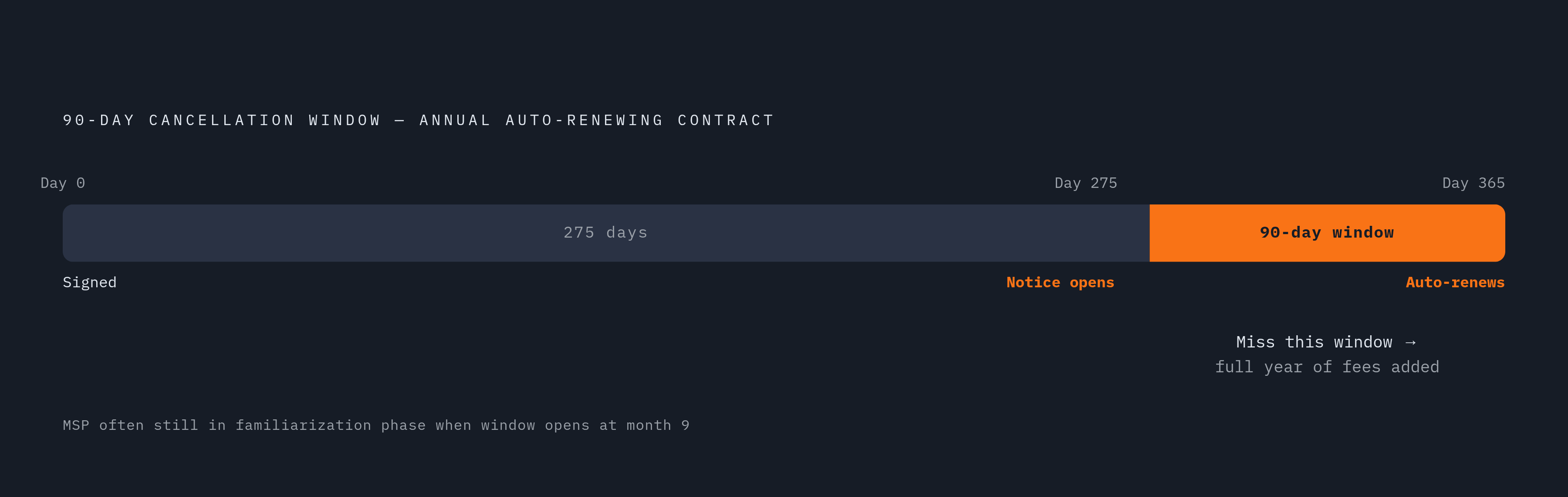
Auto-renewal is the most common way MSPs end up stuck in contracts they no longer want. The structure is simple: the agreement rolls over for a full additional term unless the MSP sends written cancellation inside a narrow window, and if that window closes, the contract renews whether the MSP meant it to or not.
The number that actually matters in these clauses is the length of the notice window, not the length of the term. If a contract auto-renews annually but requires 90 days' notice to cancel, the MSP has to make an exit decision, and act on it, three months before the contract year ends. In practice, the MSP often has to make that call while still getting familiar with the platform, well before any real dissatisfaction has had time to develop. Miss that 90-day window by even a week, and the result is the same as never having tried to leave: another full term, another full year of fees, locked in by a calendar date rather than a business decision.
This structure is not an accident of drafting. A contract that pairs auto-renewal with a 90-day notice requirement is built to retain the customer, not to serve the customer's convenience, and the asymmetry between how long the vendor gets to collect fees and how little time the MSP has to object is deliberate. MSPs negotiating these terms should ask for a written obligation on the vendor to notify them as the cancellation window approaches, a shorter notice period, or an opt-in renewal structure in place of the default opt-out.
Annual price increase provisions that leave MSPs with no exit and no ceiling
Auto-renewal locks the MSP into staying. A second clause, just as common, determines what staying actually costs: the provision governing annual price increases. A contract that fixes the price in year one but leaves future increases to the vendor's discretion hands all the pricing risk to the MSP, while the vendor's revenue for the term is already locked in regardless of what happens to the MSP's margins.
Two examples from the backup market show how this plays out in practice. Veeam raised prices again in January 2026, the second year in a row, and if that keeps up, it will add up fast against the multi-year cost models MSPs build for their own clients. Datto ran a "High Watermark" billing model for years, charging MSPs based on their peak seat or endpoint count even after a client's usage had dropped. Kaseya ended that model in December 2025, and at the time of the Datto acquisition in June 2022, prices had already come down by roughly 10%. That relief came from sustained pushback by MSPs, not from any contractual protection written into the agreements themselves.
Neither situation had anything to do with the underlying backup technology. Both were the direct result of a contract that left the price open-ended. The fix is specific: a written cap on annual price increases, stated as a fixed percentage and included in the master service agreement itself, not a verbal reassurance from a salesperson during the pitch.
Egress fees and hidden cost architecture that erode margins after signing
Even a contract with a fair starting price and a capped renewal can still cost more than it looks like it will, because the number an MSP negotiates up front is rarely the number they end up paying. Egress fees, per-agent charges, and storage tier overages let a vendor compress an MSP's margin without ever touching the headline rate in the contract.
Egress fees are the clearest version of this. A vendor can quote a competitive per-endpoint price while the real cost is in outbound data transfer charges buried in the fine print, charges that scale with how much data gets restored and grow as a client's data footprint grows. A lower per-endpoint rate from a vendor that doesn't disclose egress costs upfront can end up more expensive in practice than a higher rate from a vendor that charges nothing to move data out. Datto's proprietary cloud architecture is a concrete case: restoring data outside the Datto ecosystem brings friction and fees that rarely make it into the sales conversation.
Microsoft 365 backup is a related blind spot. Native retention inside M365 is not backup, and when vendors don't fold SaaS protection into their base offering, the quote omits those costs, which appear later on the invoice. Datto, for instance, requires a separate SaaS Protection product to cover M365, sold as a standalone product.
The honest way to compare vendors is to add up license cost, infrastructure, storage, egress, switching cost, and operational overhead, all together, as one number. Most MSPs stop after the first two. Before signing, the contract should spell out every egress and retrieval fee directly, not in a separate rate card handed over later, define what triggers an overage charge, and state whether M365 or other SaaS workloads require a separate paid add-on.
Proprietary formats and ecosystem bundling that make the cost of leaving prohibitive
The most durable kind of lock-in has nothing to do with termination fees. It comes from an architecture that makes switching so disruptive and so expensive that the MSP never attempts it, no matter what the contract technically allows.
That architecture works on three levels at once. Backup formats are proprietary, so data can't be restored with another vendor's tools, and migrating to a new platform means re-backing up everything from scratch, which is rarely practical in the middle of a contract term. Proprietary hardware goes further: the backup software only runs on appliances the vendor supplies, so the MSP depends on that hardware long after any contractual complaint has been resolved or abandoned. Ecosystem bundling adds a third layer: when backup is tied to RMM, PSA, and documentation tools from the same vendor, as it is inside the Kaseya ecosystem, leaving the backup platform means pricing out the cost of replacing the entire stack, not just one product.
When an MSP standardized on a single vendor's ecosystem hits a platform outage, it doesn't just lose backup functionality for a while. Monitoring slows down, ticket workflows get disrupted, and visibility across the business drops, even though no single tool actually broke. The dependency structure itself produces that systemic effect. This is the reason multi-vendor and marketplace models exist as a deliberate design choice rather than a convenience: a marketplace model that partners with vetted backup providers while keeping architectural consistency through a single orchestrator spreads this structural risk across vendors instead of concentrating it in one. Before signing with any single-vendor ecosystem, an MSP should get contract language stating whether backup formats are open or proprietary, a written data portability provision describing how data comes out at exit, and an honest internal accounting of which other products in the stack would need replacing at the same time.
Liability caps and SLA language that make vendor security promises unenforceable
A vendor can make confident promises about security and recovery during the sales process and still write a contract that enforces none of them. The distance between what gets said in the pitch and what gets written into the clause is where the MSP's real risk sits.
Two clauses create that distance. Liability caps are the first: many backup vendor contracts limit the vendor's total liability to one year's fees, and some more aggressive terms cap it at one to three months. If a vendor is contractually on the hook for security but financially exposed for only a month of fees, there is little financial incentive built into the contract for the vendor to maintain that security rigorously. The second is "best efforts" language in the SLA. A commitment to use "best efforts" instead of stating specific, measurable numbers isn't an SLA. It functions as a disclaimer wearing the shape of a commitment, and a response-time promise is only as solid as the contract's definition of what counts as "critical."
Several backup-specific protections are routinely missing from vendor contracts altogether: backup frequency and retention period stated as explicit numbers, RPO and RTO expressed as measurable outcomes (a "backup succeeded" message is not the same thing as a guaranteed recovery time), a contractual requirement for recovery testing, since job-completion logs confirm nothing about whether a restore actually works, and escalation paths that are written down. What a contract should include instead: a liability cap sized to match the actual risk the vendor is being asked to carry, SLA metrics with defined severity levels and a reporting mechanism the MSP can audit on its own, and a requirement for periodic recovery testing with documented results attached.
Data return and IP ownership clauses that leave MSPs empty-handed at exit
An MSP can do everything right during negotiation and still find that the vendor keeps the client's data, the configurations built on the platform, or the documentation and automation the MSP's own team created, because nothing in the contract ever said who owned those things.
Two categories of assets are exposed here. Client data is the first: contracts frequently leave unanswered how long backups stay on the vendor's infrastructure after termination, when they get deleted, and who confirms that deletion actually happened. Confidential client data can sit on a former vendor's servers indefinitely after the relationship has ended. Work product is the second: some contracts give the vendor ownership of, or exclusive access to, the configurations, scripts, network diagrams, and automation tools the MSP built while using the platform, so the MSP cannot take any of that work when they leave.
This matters beyond the commercial relationship itself. MSPs supporting regulated industries, healthcare, finance, defense, manufacturing, get asked during compliance reviews to document data residency and access controls for their backups. If the vendor's exit terms are vague, it's the MSP standing in front of the auditor explaining the gap, not the vendor. Before signing, an MSP should get an explicit number of days for data return after termination rather than a promise of "promptly," a written certification of deletion, clear IP ownership language stating that configurations and documentation the MSP built belong to the MSP, and a transition assistance provision obligating the vendor to support migration for a set period.
What MSPs outside the EU still have to negotiate
The EU Data Act took effect on 12 September 2025, and since then it has set the minimum standard for backup vendor contracts that cover EU customers. Outside the EU, the contract an MSP signs is still all the protection it has.
The Act requires SaaS providers to remove contractual and technical barriers that stand in the way of switching, to cap the notice period for contract termination at two months, and to guarantee secure, timely data transfers, a requirement that applies to new contracts and existing ones alike, including those with fixed terms. Starting 12 January 2027, it will also ban switching charges outright, including the one-off data-egress fees vendors now impose at exit. The Act reaches beyond EU borders and covers non-EU providers that serve EU customers.
So for MSPs with EU clients, many of the worst egress-on-exit and data-return clauses described above will stop being enforceable, at least for contracts within the Act's scope, but only once the egress prohibition takes effect in January 2027. MSPs operating mainly in the United States have no federal equivalent to rely on. Protections come entirely from the service agreement itself, so every clause covered in this article stays fully negotiable, and that makes it fully the MSP's job to address before a signature goes on the page.
What to do before signing a backup vendor contract
Read the contract before the demo closes. You have leverage over these terms exactly once, in the window before signature, and it disappears the moment the agreement is executed. Every clause covered here, auto-renewal windows, price increase caps, egress disclosure, format and hardware portability, liability caps, SLA specificity, data return timelines, and IP ownership, needs a direct answer in writing before an MSP commits a client's data and their own margin to a platform. A vendor confident in its product should have no difficulty agreeing to put these terms in writing, because a contract that already favors the MSP costs the vendor nothing to sign. The MSPs who end up protected are the ones who treated the contract, not the platform demo, as the real evaluation.